Why Learn Pinyin First? A Smarter Way to Start Mandarin
If you’re starting to learn Mandarin Chinese, you’ve probably asked yourself: Should I learn Chinese characters first, or Pinyin? Our answer is simple: start with Pinyin. Here’s why — and how to do it effectively.
TL;DR: Pinyin is the phonetic system for Chinese. It uses Latin letters and tone marks to represent the pronunciation of every Chinese character. With only 23 initials, 24 finals, and 4 tones — forming just over 400 distinctive pronunciations — Pinyin gives you the entire sound system of Mandarin in a fraction of the time it would take to learn thousands of characters. Start with Pinyin, and everything else becomes easier.
What is Pinyin?
Answer: Pinyin is the phonetic symbol system for Chinese. It uses Latin letters and tone marks to annotate the pronunciation of every Chinese character.
In Chinese Pinyin, there are:
23 initials (the beginning sounds)
24 finals (the ending sounds)
4 tones (plus a neutral tone)
Their combinations form just over 400 distinctive pronunciations, which together cover all possible pronunciations of Mandarin Chinese characters.
In other words, if you master Pinyin, you have the phonetic key to every Chinese character.
Why should you learn Pinyin first?
Answer: Because Pinyin is the foundation of pronunciation, it’s far easier to learn than characters, and it’s friendly to anyone who already knows the Latin alphabet.
1. Pinyin is the foundation of pronunciation
Pinyin is the foundation of Chinese pronunciation practice and correction. Without it, you have no reliable way to know how a character should sound. It’s the map that tells you where every sound lives — and without a map, you’re guessing.
Every Chinese character has a specific pronunciation, and many characters share the same sound. Pinyin is the only system that lets you see that sound clearly, without having to memorize it character by character.
2. Pinyin is much easier to learn
Compared to directly learning Chinese characters, Pinyin is far simpler.
There are over 5,000 commonly used Chinese characters, and many of them share the same pronunciation. Pinyin, by contrast, has only about 400 distinctive combinations that cover all possible Chinese character pronunciations.
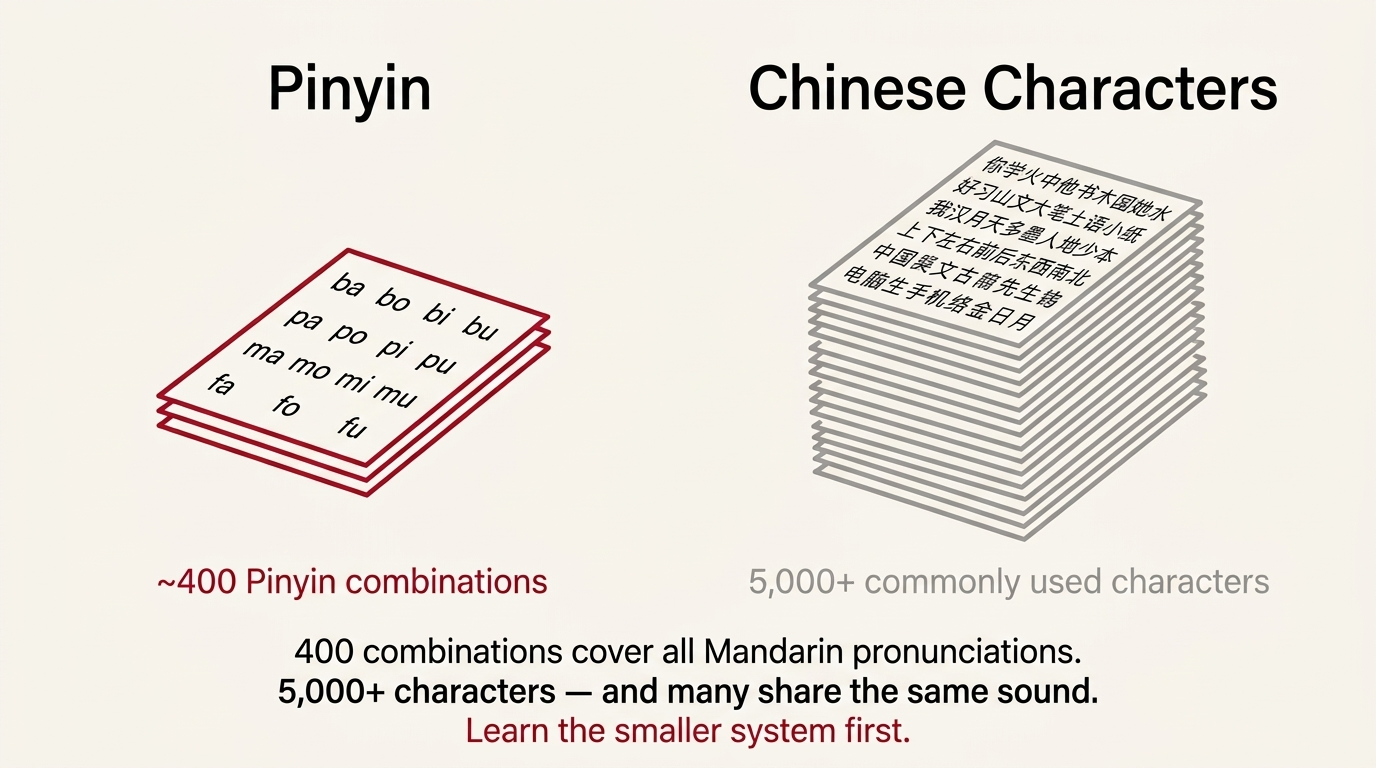
That means you can learn the entire pronunciation system in a fraction of the time it would take to learn characters alone. And once you’ve learned it, you can pronounce any new character you encounter — even if you’ve never seen it before.
3. Pinyin is friendly to Latin letter users
Pinyin is composed of Latin letters and tone symbols, making it much more approachable for learners already familiar with the Latin alphabet.
This is why even Chinese natives study Pinyin first in elementary school. And it’s why learning Mandarin pronunciation starting from Pinyin is significantly easier and more effective than starting from Chinese characters.
Does Pinyin help with self-study later on?
Answer: Yes. Pinyin isn’t just for beginners — it’s a long-term investment.
Pinyin is the annotation system for Chinese character pronunciation. There are countless Chinese books and articles that include both Chinese characters and their Pinyin. By mastering Pinyin pronunciation, you can read those materials with confidence — even when you encounter characters you’ve never seen before.
In some cases, you can even use Pinyin alone to communicate with Chinese natives — because every Chinese native learns Pinyin when they enter elementary school. It’s a shared system that both learners and native speakers understand.
What’s the right way to learn Pinyin?
Answer: Follow a structured course that takes you from the basics to confident mastery — with dimension-level feedback at every step.
Most Chinese learning apps use speech recognition to give you a rough score: correct or incorrect, 80% or 90%. That’s not enough to actually improve. CPAIT was built on a different principle. Its 28-lesson Pinyin Bootcamp combines structured teaching with dimension-level pronunciation diagnostics — every attempt tells you whether the error is in the initial, the final, or the tone. From there, you can drill down into the smallest error unit and jump straight into targeted correction exercises with one click.
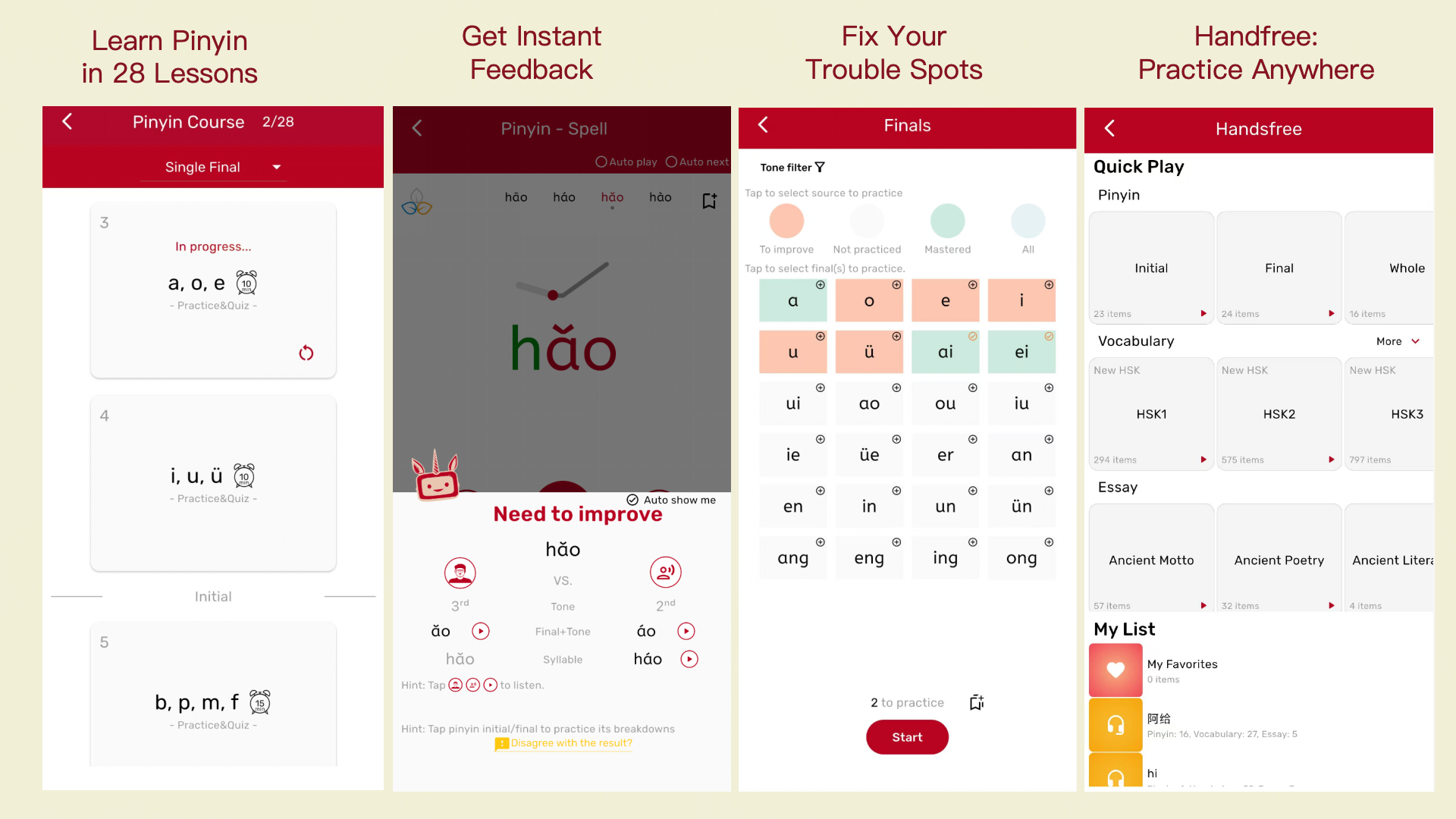
Here’s what the course includes:
28 mini-lessons (2–15 minutes each) — from “a o e” to confident mastery, in a clear, step-by-step order. The short format makes it easy to start and easy to stay consistent.
Smart AI Coaching — available anytime, endlessly patient, and never judgmental. You can practice the same sound a hundred times without feeling embarrassed, and without worrying about a teacher’s schedule or price.
Instant, dimension-level feedback — every attempt tells you whether the error is in the initial, the final, or the tone.
Visual waveform comparison — tone contours are displayed clearly, so you can see exactly how your pitch compares to the native model.
Targeted Practice — you can select your personal trouble spots and drill them directly.
Proven Method — every unit follows a Learn → Practice → Test → Review cycle, so new content is constantly reinforced.
Beyond the structured course, CPAIT also includes a self-directed Pinyin practice module. If you already know which sounds trip you up — say, the third tone, or the ü vowel — you can jump straight into targeted practice units for those specific weak spots, without repeating what you’ve already mastered.
And when you want to practice without sitting at a screen, Handfree mode lets you shadow and train your ear while you’re at the gym, doing chores, or on a walk. It turns otherwise idle time into pronunciation practice — making learning feel lighter, and progress more consistent.
This course is perfect for:
Absolute beginners
Self-taught learners who need structure
Anyone tired of being misunderstood when they speak
Stop guessing Chinese pronunciation. Follow the system, and you’ll build the foundation that makes everything else easier.
The Bottom Line
Pinyin isn’t a shortcut — it’s the smartest first step. It gives you the pronunciation foundation that makes everything else easier: listening, speaking, vocabulary retention, and self-study.
If you’re starting Mandarin from zero, don’t skip Pinyin. It’s the key that unlocks the entire sound system of Chinese.
Ready to stop guessing? [If you’d like to try it, you can download CPAIT on the App Store or Google Play — and start the 28-lesson Pinyin Bootcamp, from “a o e” to confident mastery, with instant AI feedback on every sound you practice.
References
This article is based on standard principles of Chinese phonetics and language pedagogy. For further reading on pronunciation acquisition and Pinyin instruction, see:
Neal, R. (2020). Knocking tones off their perch: Investigating the intelligibility of Anglophone beginner learners of Mandarin Chinese at two secondary schools in the North of England [PhD thesis]. University of Cambridge.
Selinker, L. (1972). Interlanguage. IRAL — International Review of Applied Linguistics in Language Teaching, 10(1–4), 209–232.
Further Reading
- How to Start Learning Chinese from Zero: The Complete Beginner’s Roadmap
- What Are Chinese Tones and Why Do They Matter?
- Why Can’t I Understand Chinese After Years of Studying?
- How Can I Fix My Chinese Pronunciation?
- How to Improve Chinese Listening and Speaking: The 3 Foundations Most Learners Miss
Frequently Asked Questions
What is Pinyin?
Pinyin is the phonetic symbol system for Chinese. It uses Latin letters and tone marks to annotate the pronunciation of every Chinese character. It consists of 23 initials, 24 finals, and 4 tones, whose combinations form just over 400 distinctive pronunciations covering all Mandarin characters.
Should I learn Pinyin or Chinese characters first?
Learn Pinyin first. There are over 5,000 commonly used Chinese characters but only about 400 Pinyin combinations. Mastering Pinyin first gives you the pronunciation key to every character, making later character learning faster and more accurate.
How long does it take to learn Pinyin?
With CPAIT’s Pinyin Bootcamp, the full course is 28 mini-lessons, each lasting 2–15 minutes. You can complete the basics in a few weeks of focused practice. But mastering them in connected speech takes longer. The key is to start early and practice daily.
Is Pinyin only for beginners?
No. Pinyin is a long-term tool. It’s used in dictionaries, textbooks, and input methods. Even advanced learners rely on Pinyin when encountering new characters or checking pronunciation.
Can I learn Chinese without learning Pinyin?
It’s possible, but much harder. Without Pinyin, you have no reliable way to know how a character should sound. You’d be relying on memorization and imitation alone — which is slower and more error-prone.
How is CPAIT different from other Chinese learning apps?
Most apps use speech recognition to give you a holistic score — “80% accurate” or “try again.” CPAIT goes further. It diagnoses your pronunciation across three dimensions (initial, final, and tone), tells you exactly where the error is, and then lets you drill into that specific unit with targeted correction exercises. Instead of guessing what to fix, you always know.