Why a Chinese Pronunciation Score Isn't Enough
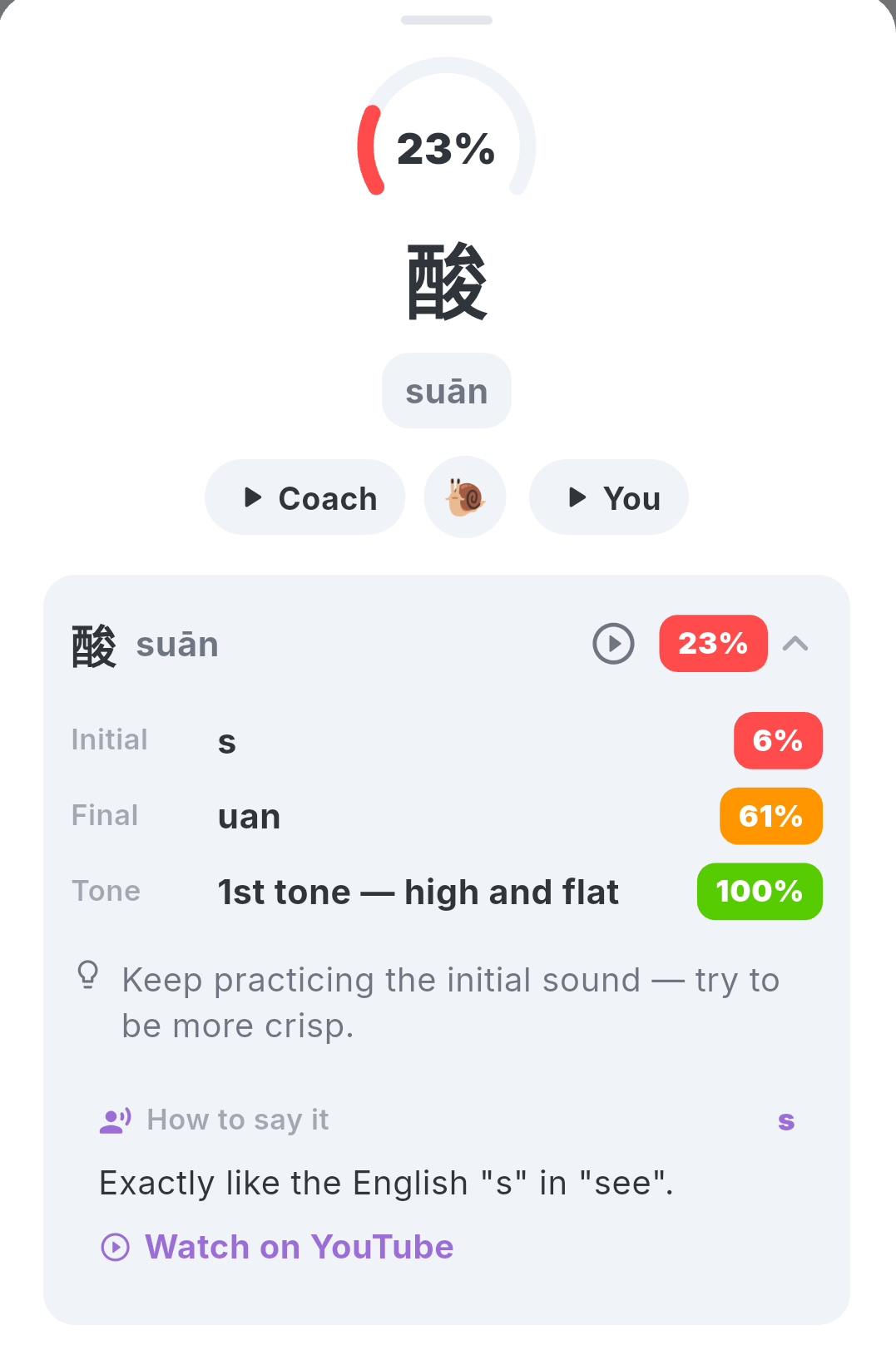
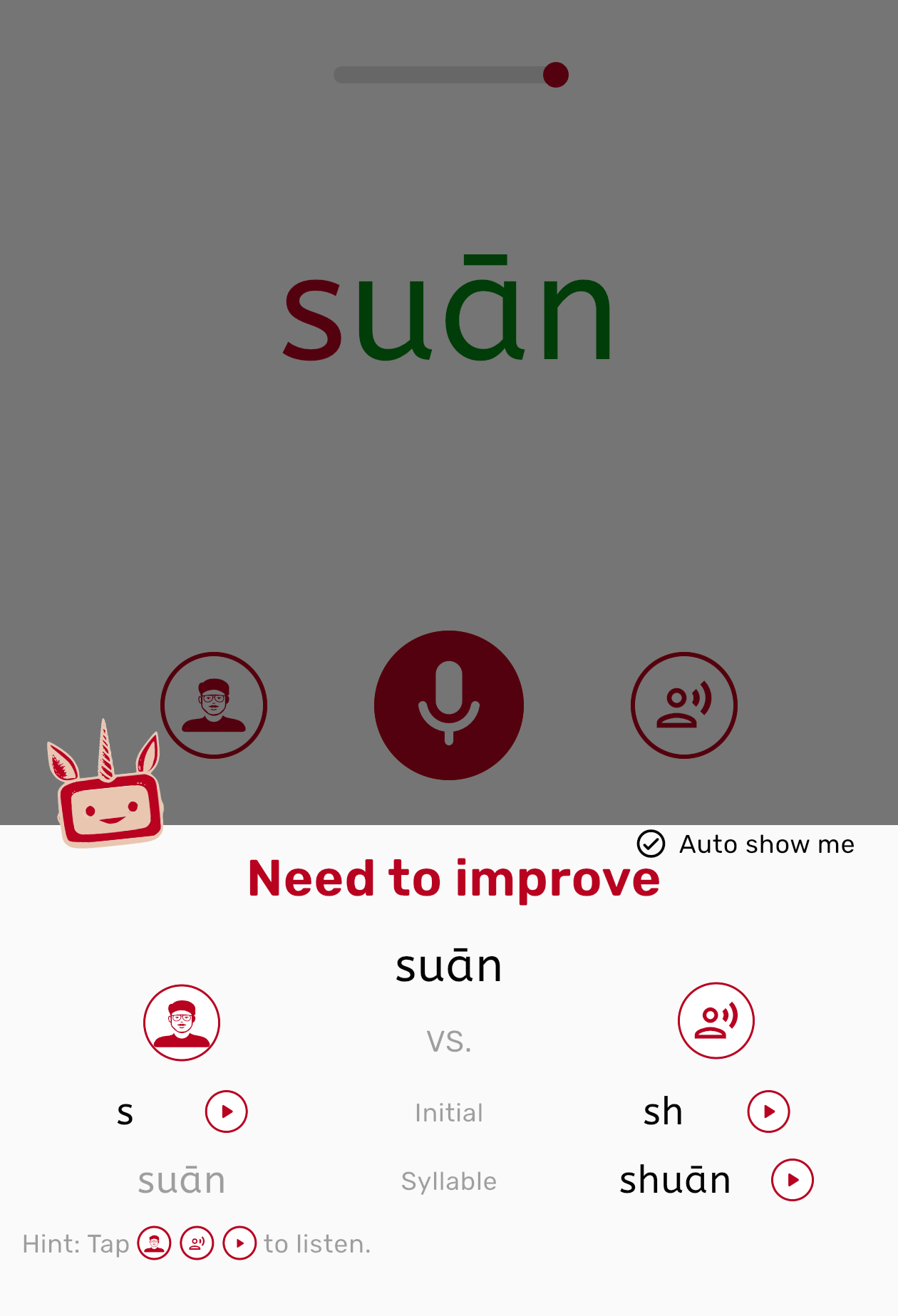
You record yourself saying a word in Mandarin. The app thinks for a second, then hands you a number: 72%.
Now what?
Do you say it again the exact same way and hope for a higher number? Do you slow down? Speed up? Was it your tone that was off, or did you actually say the wrong consonant? A Chinese pronunciation score on its own can’t tell you any of that — and that gap is exactly why so many learners plateau even while diligently grinding through pronunciation drills.
A score is a verdict. What learners actually need is a diagnosis.
The problem with a single number
A pronunciation score compresses three genuinely different things — your initial consonant, your final vowel, and your tone — into one blended figure. That’s convenient for a leaderboard, but useless for correction.
Say you’re practicing 拼 (pīn) and you get a 65%. That 65% could mean:
- You nailed the initial “p” and the final “in,” but your tone drifted from a flat first tone into something closer to a second tone.
- Your tone was perfect, but you pronounced the initial as a “b” instead of a “p” — a classic aspirated/unaspirated mix-up for English speakers.
- Everything was close-ish, with small errors spread across all three components, none of them individually severe.
Three completely different problems, three completely different fixes — and the exact same score. This is the core failure mode of most pronunciation feedback: it optimizes for a satisfying-looking metric instead of an actionable one. If the number doesn’t change your next attempt, it wasn’t feedback. It was a grade.
Score → component → diagnosis
Useful Mandarin pronunciation feedback has to go through three stages, not one:
1. Overall score — a single blended number, useful only as a rough gauge of progress over time. It tells you how far off you were, averaged across everything.
2. Component scores — the overall number split into three separate scores: one for the initial, one for the final, one for the tone. This is already a real improvement, and it’s further than most apps go. Instead of “72%” you get something like “Initial: 95%, Final: 90%, Tone: 45%” — which at least tells you where the problem lives.
3. Diagnosis — naming what actually went wrong, in terms a learner can act on immediately. Not “tone: 45%,” but “you pronounced this as a second tone (rising) instead of a first tone (flat, high).” Not “initial: 60%,” but “you said ‘p’ where the target was ‘b.’”
That last step is the one that turns feedback into something a learner can actually use on their very next repetition. “Try again” is not instruction. “Your tone dipped down at the end instead of staying flat — try holding the pitch level all the way through” is.
Overall score vs. component scores: progress, but not the finish line
It’s worth pausing on step two, because component scores are a genuine upgrade over a single blended number — and it’s tempting to stop there and call it a solved problem.
Take that same example: 拼 (pīn) scored at “Initial: 95%, Final: 90%, Tone: 45%.” Compared to a flat 72%, this is immediately more useful — you now know the tone is the weak link, not the consonant or vowel. That’s real signal, and any app doing this split is already ahead of one that isn’t.
But notice what’s still missing: a 45% tone score tells you how wrong your tone was, not which tone you actually produced instead of the target one. Did you flatten a first tone into something close to neutral? Did you swing it upward into a second tone? A percentage can’t distinguish between those, even though the correction for each is completely different. Two learners can both score “Tone: 45%” while making opposite errors — one needs to stop letting their pitch drift up, the other needs to stop letting it drift down. The same number, two opposite fixes.
This is the gap between a component score and a component diagnosis. Scores — whether overall or per-component — are measurements of distance from a target. A diagnosis is a description of the actual substitution that happened. You need the first to track progress and the second to know what to change.
Why most apps stop at a score
Stopping at scores — whether one blended number or three component numbers — isn’t a design choice so much as a reflection of what’s technically easy to ship. Comparing a learner’s audio against a reference recording and outputting a similarity percentage, even split three ways into initial/final/tone, is a well-understood acoustic modeling problem. Going further — identifying the specific substitution that occurred and translating it into plain language a learner can act on — is a much deeper pipeline. It means the system has to actually understand Mandarin phonology, not just measure acoustic distance.
That’s the difference between a similarity score — overall or component-level — and real AI pronunciation feedback. A score, at either level, answers “how close was this to correct?” A diagnosis answers “what specifically do I need to change?” — which is the only question a learner is actually asking when they look at their result.
What this looks like in practice
When pronunciation evaluation runs at the component level, a learner working on tone pairs gets told, specifically, which tone they produced versus which tone they were aiming for — not just that their “tone score” was low. A learner mixing up aspirated and unaspirated initials (b/p, d/t, g/k — one of the most common and persistent errors for English speakers) gets told exactly which sound substitution happened, every time it happens, until the pattern breaks.
Over enough repetitions, that specificity compounds. A vague score trains a learner to associate certain words with vague frustration. A precise diagnosis trains a learner to associate certain sounds with a specific, correctable habit — which is a much shorter path to actually fixing it.
The takeaway
A Chinese pronunciation score is a summary, not a lesson. If your pronunciation practice isn’t telling you which component broke down and what the actual error was, you’re being graded, not taught. The next time an app hands you a number, ask what’s underneath it — because the number was never the point.