What Are Chinese Tones and Why Do They Matter?
If your native language doesn’t use pitch to distinguish word meanings, tones can feel like an optional decoration. They’re not. In Chinese, tones are the word itself.
TL;DR: Chinese is a tonal language. Every syllable carries a specific tone, and changing the tone changes the meaning entirely. The same syllable ma can mean “mother,” “hemp,” “horse,” or “scold” depending on its tone. Ask most experienced Chinese teachers what the hardest part of teaching Mandarin is, and tones will almost certainly come up. Research shows that learners often can’t hear their own tone errors without feedback — which is why tones need to be practiced early, with immediate, dimension-level feedback.
What are Chinese tones?
Answer: Chinese tones are pitch patterns that distinguish word meanings. Mandarin has four main tones plus a neutral tone. Every syllable carries one of them — and you can’t separate the tone from the word.
Here’s how the four tones work, using the syllable ma as an example:
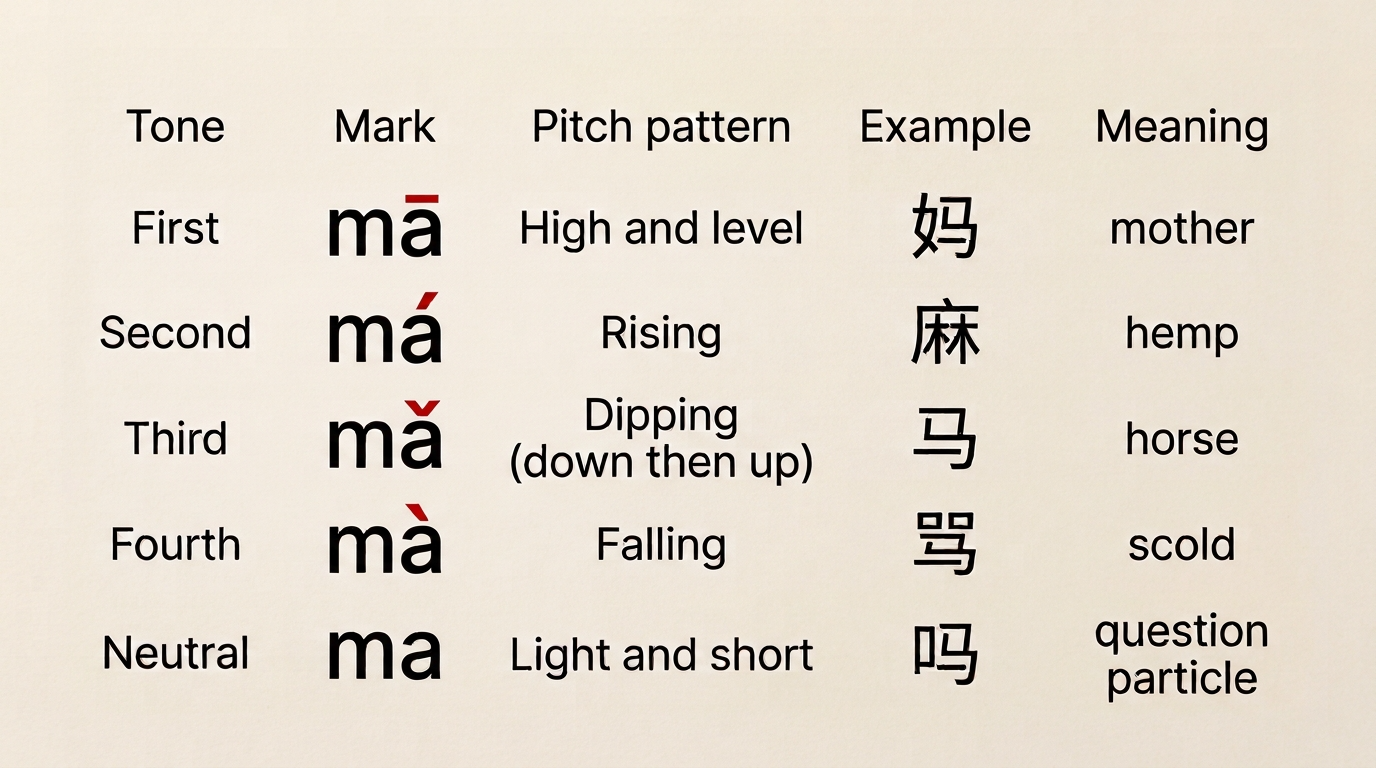
These aren’t subtle accent variations. They are completely different words. If you say mā when you mean mǎ, a native speaker will hear “mother” instead of “horse” — or simply be confused.
Take the word 好 (hǎo, “good”). Its Pinyin is made up of three parts:
h — the initial (声母)
ao — the final (韵母)
ǎ — the tone mark on the final (声调)
The initial and final are visible. You can see them, spell them, and practice them. The tone is different. It’s a pitch contour — a shape your voice has to make — and if your native language doesn’t use pitch to distinguish word meanings, your ear has never been trained to notice it.
Why do beginners underestimate tones?
Answer: Because in most non-tonal languages, pitch doesn’t change word meaning. So the brain treats it as background noise — something to ignore, not something to learn.
In English, pitch operates at the sentence level. A rising pitch at the end of a sentence signals a question. A falling pitch signals a statement. But the individual words stay the same. If you say “coffee” with a rising pitch, it’s still coffee — just a question about it.
In Mandarin, pitch is a property of each individual syllable. You cannot separate the tone from the word. Learning a word without its tone is like learning a word without its vowels — it’s incomplete.
This is why many beginners assume tones are just a decorative accent, something they can pick up later. The assumption feels natural. But it’s dangerously wrong.
Why do experienced teachers say tones are the hardest part?
Answer: Because for most learners, tone is the one element their native language never trained them to hear or produce — and it doesn’t go away after the beginner stage.
Ask most experienced Chinese teachers what the hardest part of teaching Mandarin is, and tones will almost certainly come up. Many of them will tell you they spend a significant amount of class time on tone accuracy, and that for most foreign students, tone remains a challenge long after the initial and final sounds have been mastered. Some students end up spending time correcting their tones throughout their entire learning journey.
This isn’t a beginner problem that disappears with time. It’s a persistent one — which is why it’s worth getting right from the start.
Why are Chinese tones so important?
Answer: Because they are the word. Getting the tone wrong doesn’t just make you sound foreign — it makes you hard to understand.
Research consistently shows that tone acquisition is the most difficult aspect of Chinese pronunciation for non-tonal language learners. Neal’s (2020) study at the University of Cambridge on the intelligibility of beginner Mandarin learners found that “intelligibility breakdowns” — moments when listeners failed to correctly transcribe what learners intended to say — could be traced to problems with individual words, which “usually implicated segmental sounds as well as tone.”
In other words, tone errors actively impede comprehension. They’re not something you can fix later.
And here’s the part that makes it harder: Neal also found that “all learners demonstrated low levels of awareness of their own pronunciation errors both during and after speech production,” while “learners who were more intelligible were generally more aware of their own pronunciation errors.” In other words, the learners who most need feedback are often the least equipped to recognize their own mistakes.
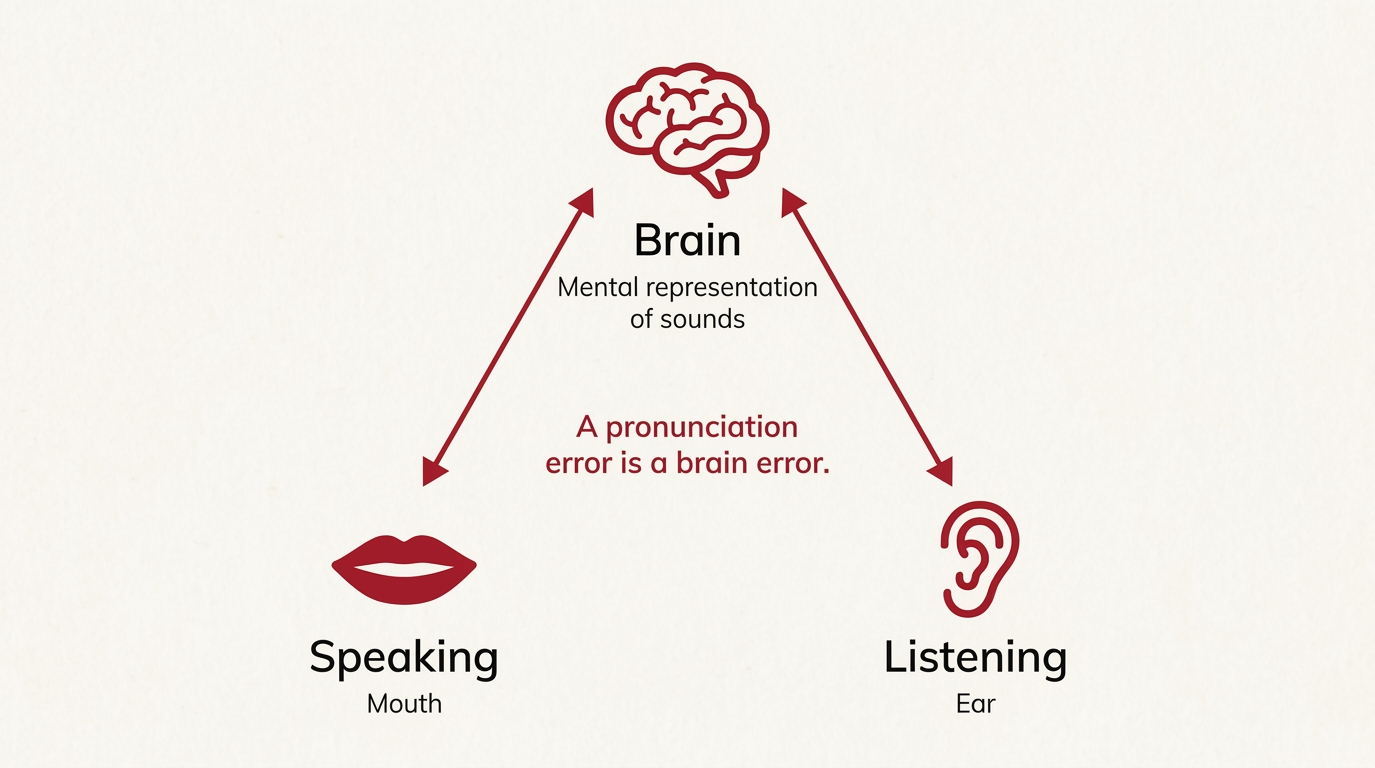
You can’t fix a tone error you can’t hear.
What is tone sandhi, and why does it matter?
Answer: Tone sandhi is the way tones change depending on their position in a phrase or sentence. It’s a major source of persistent errors — even for intermediate and advanced learners.
The most well-known example is the third-tone sandhi rule. 好 (hǎo) is a third tone on its own. But in 你好 (nǐ hǎo, “hello”), the first syllable nǐ is also a third tone — and when two third tones occur consecutively, the first one changes to a second tone. So even though it’s written nǐ hǎo, what you actually say is ní hǎo. The first syllable is no longer third tone, even though the Pinyin still marks it that way.
There are many other sandhi rules that learners must internalize. Research on Indonesian learners of Mandarin, for example, found that while most students could produce the four tones in isolation, bisyllabic tone sandhi remained a significant challenge, recommending that instruction be sequenced strategically (Autar & Nurhaliza, 2019).
This is why learning tones in isolation isn’t enough. You need to practice them in context — in real words, real phrases, real sentences. And because tone sandhi and neutral tones follow their own rules, they deserve dedicated practice.
Why is tone acquisition harder for some learners?
Answer: Because your native language shapes how you hear pitch. If your first language doesn’t use pitch to distinguish words, your brain has to build a new perceptual category.
For speakers of non-tonal languages like English, Spanish, or French, this is a genuinely new cognitive challenge. Research on Korean L2 learners of Mandarin, for example, found that intermediate learners showed “no systemic modulations for focus marking,” and even advanced learners’ prosodic patterns were “significantly different from those of native speakers.”
The good news: tone perception can be trained. Studies show that learners with no prior tone language experience can become highly accurate at identifying tones in isolation. The challenge is using tones to differentiate real words in real time — which requires practice with immediate feedback.
For the deeper link between perception and production — and why tone errors affect both listening and speaking — see How Can I Fix My Chinese Pronunciation?.
How can you practice Chinese tones effectively?
Answer: Practice with immediate, specific feedback — not just listening and repeating, but adjusting your lips, tongue, and breath until the sound is physically correct, then repeating it until it becomes automatic. Tone sandhi and neutral tones deserve the same deliberate practice, not passive exposure.
How CPAIT helps you practice Chinese tones
Immediate, dimension-level feedback. Every attempt tells you whether the error is in the initial, the final, or the tone — not just a holistic score. You can hear the difference, see where it went wrong, and adjust your lips, tongue, and breath on the next attempt. Saito and Lyster (2012) demonstrated that learners who received targeted corrective feedback improved significantly, while control groups did not. For the full study, see How Can I Fix My Chinese Pronunciation?.
Visual waveform comparison. Tone is pitch, and pitch is hard to hear in your own voice. CPAIT shows your tone contour against the native model, so the error becomes visible — not just audible. You can see whether your pitch started too low, rose too slowly, or fell too early, and correct it on the next repetition.
Contextualized practice. Isolated syllable drills have their place, but real speech involves tone sandhi, stress, and intonation. 你好 (nǐ hǎo) is written with two third tones, but pronounced ní hǎo. CPAIT lets you practice these patterns in real words and sentences, not just in isolation.
Dedicated tone sandhi and neutral tone lessons. CPAIT offers 8 mini-lessons on tone sandhiand 8 mini-lessons on neutral tones — the two areas that cause the most persistent errors get their own systematic treatment, rather than being treated as an afterthought.
Consistency built into daily life. A few minutes every day beats a once-a-week cram session. Handfree mode lets you practice tones during your commute, at the gym, or while doing chores — no screen required.
CPAIT’s Pinyin course covers different Pinyin combinations and tone practice from the ground up. Its pronunciation diagnostics break down every attempt by initial, final, and tone — with an assessment accuracy above 95% — so you know precisely what to fix. And its visual waveform comparison shows your tone contour against the native model, making pitch errors visible.
The Bottom Line
Tones aren’t a decorative accent on top of Chinese. They are the language. Get them wrong, and the words you’ve memorized become unrecognizable. Get them right, and everything else — listening, speaking, reading — becomes easier.
The learners who become genuinely proficient in Chinese are the ones who take tones seriously from day one. Not because it’s easy, but because everything else depends on it.
Ready to train your tones? Download CPAIT for iOS or Android — instant, dimension-level feedback on every tone, plus a 24/7 non-judgmental coach who’s strict, patient, and always by your side. Speak Chinese confidently.
References
Autar, A., & Nurhaliza, S. (2019). Tone teaching plan designed for Indonesian Chinese beginners. Advances in Social Science, Education and Humanities Research.
Neal, R. (2020). Knocking tones off their perch: Investigating the intelligibility of Anglophone beginner learners of Mandarin Chinese at two secondary schools in the North of England [PhD thesis]. University of Cambridge.
Saito, K., & Lyster, R. (2012). Effects of form-focused instruction and corrective feedback on L2 pronunciation development of /ɹ/ by Japanese learners of English. Language Learning, 62(2), 595–633.
Further Reading
- How to Start Learning Chinese from Zero: The Complete Beginner’s Roadmap
- Why Learn Pinyin First? A Smarter Way to Start Mandarin
- Why Can’t I Understand Chinese After Years of Studying?
- How Can I Fix My Chinese Pronunciation?
- How to Improve Chinese Listening and Speaking: The 3 Foundations Most Learners Miss
Frequently Asked Questions
How many tones does Mandarin have?
Mandarin has four main tones (high level, rising, dipping, falling) plus a neutral tone. Every syllable carries one of them.
Do I really need to learn tones?
Yes. Tones are part of the word. If you ignore them, you’ll be misunderstood — and you’ll have to relearn everything later.
What happens if I get a tone wrong?
You’ll say a different word. Mā (mother) and mǎ (horse) are different words, not different accents. Getting the tone wrong can confuse your listener or produce an unintended meaning.
Are tones really that hard to learn?
They’re challenging at first — especially if your native language doesn’t use pitch this way. But with immediate feedback and consistent practice, tone perception and production can be trained.
What's the best way to practice Chinese tones?
Listen, repeat, and get immediate feedback. Use a tool that shows you specifically which tone you got wrong, and practice in context — not just in isolation. CPAIT’s Handfree mode does this in real time, without requiring you to look at a screen.
Can I learn tones without a teacher?
Yes, but you need feedback. Without it, you can’t hear your own errors — and you may practice incorrectly for months without knowing. An AI-powered tool like CPAIT gives you that feedback instantly.
Does CPAIT cover tone sandhi and neutral tones?
Yes. Beyond the main Pinyin course, CPAIT offers 8 mini-lessons on tone sandhi and 8 mini-lessons on neutral tones. These are the two areas that cause the most persistent errors for learners, so they get dedicated, systematic practice rather than being treated as an afterthought.
How accurate is CPAIT's pronunciation assessment?
CPAIT’s diagnostics engine has an assessment accuracy above 95% when judging whether your pronunciation is correct — and if not, whether the error is in the initial, the final, or the tone. It also shows which sound your attempt is closest to, as a reference point to help you hear the difference — not as a claim that you actually produced that sound.