HSK 3.0 & HSKK are Here: Why 11,000 Words Isn’t Enough (And How Pronunciation Can Save You)
TL;DR: The Change: The new HSK 3.0 and HSKK (launching Dec 2026) require 11,092 words and shift focus to real-time output like “Listen and Retell.” The Trap: Relying purely on visual flashcards leads to “Fossilization”—hardwiring bad pronunciation that’s nearly impossible to fix later. The Solution: Master the ~400 Pinyin syllables to unlock 3,000 characters. CPAIT’s Handsfree mode trains your ear by hiding text, prompting you to retell, and giving instant pronunciation feedback.
If you are learning Mandarin, you’ve likely heard the news by now: The new HSK 3.0 and HSKK (Speaking Test) will officially launch globally on December 13, 2026.
The rules are changing. This is not just a minor tweak to the test format; it is a fundamental shift in the logic of the examination. The old six-level HSK 2.0 system will be phased out, replaced by the “Three Bands, Nine Levels” structure.
The vocabulary requirement jumps from roughly 5,000 to 11,092 words. The total number of characters reaches 3,000 (with 1,200 required for handwriting), and grammar points increase to 572. Every metric has been significantly scaled up.
When faced with this, a learner’s first instinct is usually to just “memorize.” Double the flashcards, double the vocabulary lists, double the late nights.
But if you just double down on the old methods, you will likely hit an invisible wall in the intermediate and advanced stages.
The Real Shift: Not Just “More” Vocabulary, But “Different” Output
Under HSK 2.0, many learners could scrape by just by “recognizing” characters. HSK 3.0 raises the ceiling to over 11,000 words and explicitly adds “translation” to the written skill assessment.
More importantly, the new HSKK (Speaking Test) has completely revamped its format. It has shifted from simple recitation to real-time output tasks, such as “Listen and Retell” and “Describe a Picture.”
The old path of “learn to read first, worry about pronunciation later” no longer works.
If you repeatedly practice incorrect pronunciation without feedback, your brain hardwires the mistakes—a phenomenon known as Fossilization. Because the new 9-level system extends the learning journey, it creates a much longer “fossilization window.” By the time you face the HSKK examiner and need to produce immediate oral output, it will be too late to correct your tones.
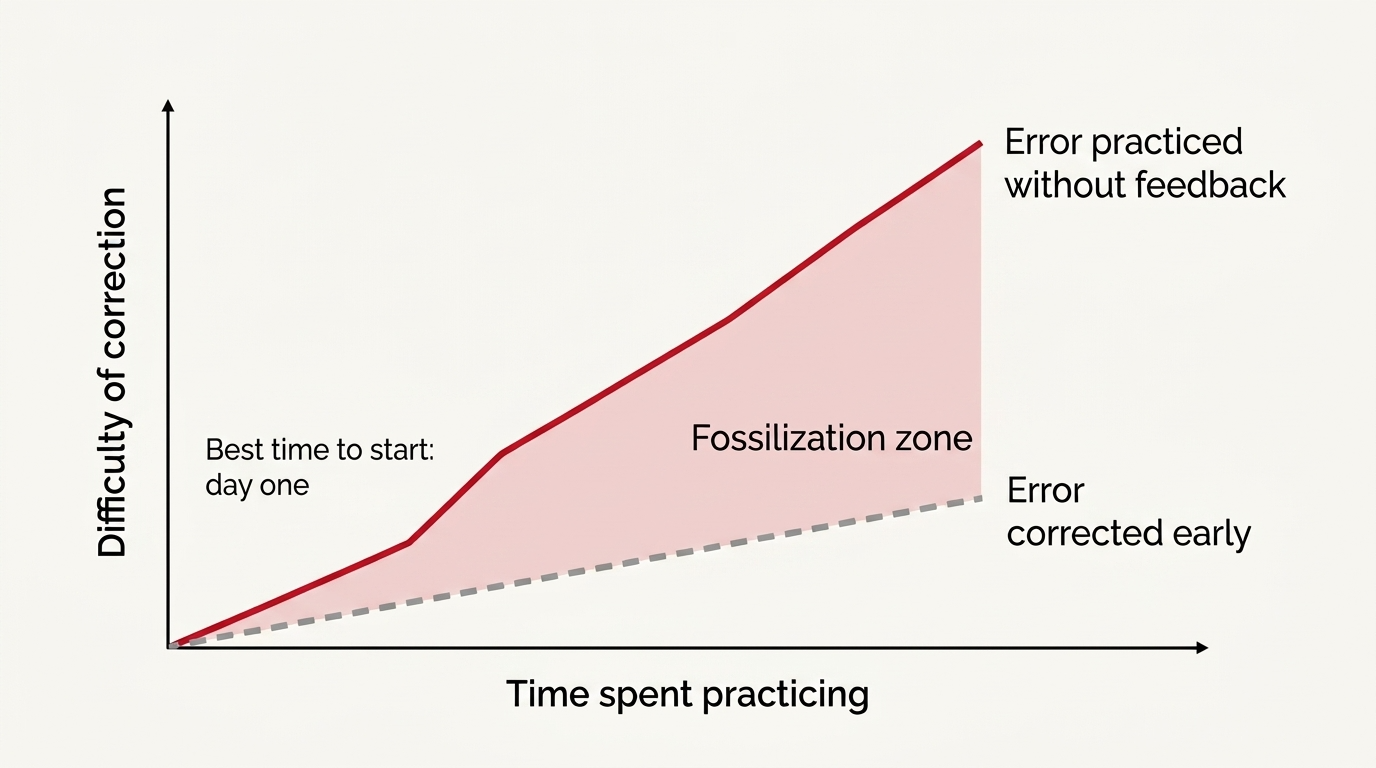
The graph illustrates the “Fossilization Zone”: errors corrected early (dashed line) stay easy to fix, while errors practiced without feedback (red area) become exponentially harder to correct over time.
Pinyin is Not Just a “Beginner Tool”: It’s a Leverage of 400 Sounds
HSK 3.0 requires you to know 3,000 characters. However, the entire Mandarin phonetic system consists of only about 400 syllables (without tones).
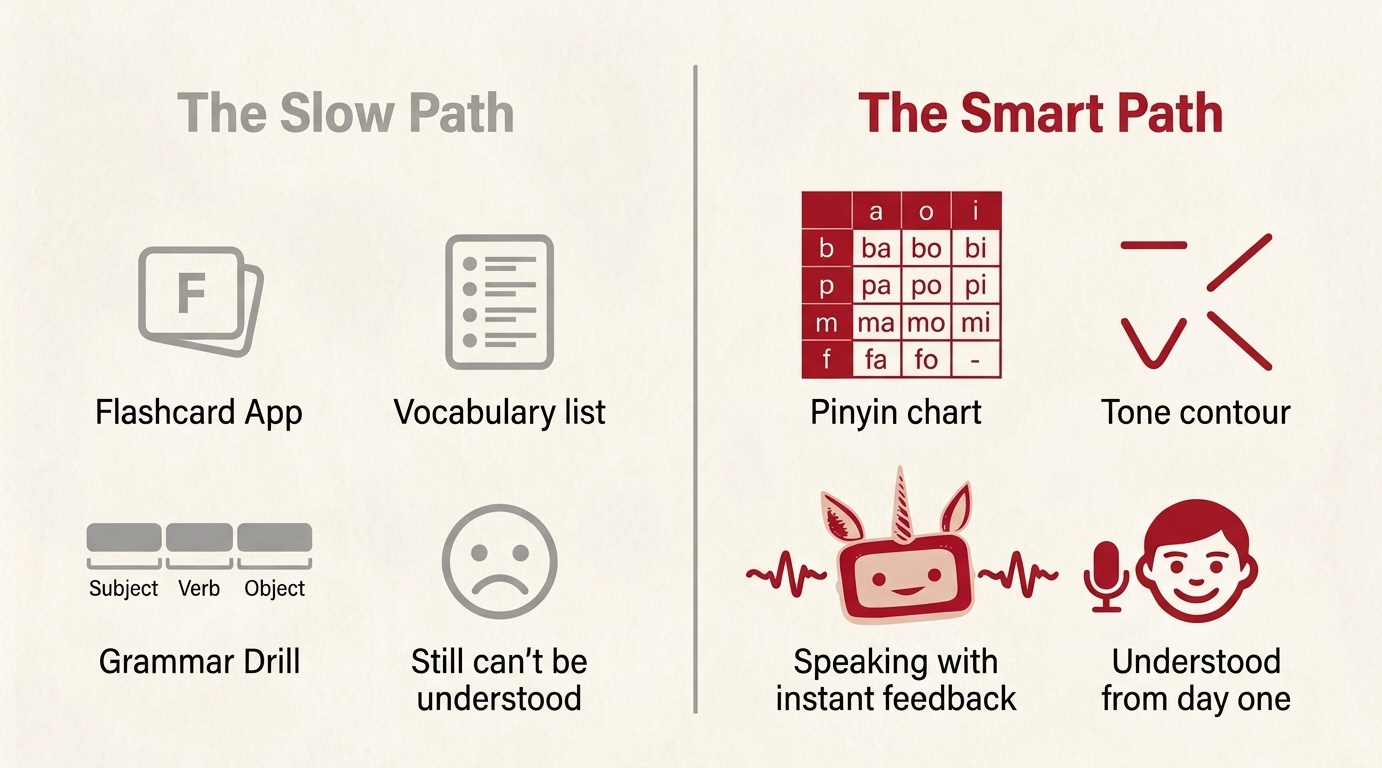
Once you truly master Pinyin and the tone system, you gain the ability to read almost any Chinese character out loud. When “reading it out” and “recognizing the character” happen simultaneously, the visual shape, the sound, and the meaning are activated together. Your brain gets a multi-sensory anchor rather than an isolated visual symbol.
This is exactly the core competency tested in the HSKK speaking tasks: Can you turn what you know in your head into accurate, comprehensible spoken sounds?
How CPAIT Helps You Close the Loop for a High Score
HSK 3.0 and HSKK leave no room for the “I’ll fix my pronunciation later” mentality. CPAIT was built on a simple premise: Make correct pronunciation your default before errors fossilize.
Strictly Aligned with the 2021 Official Standard
The vocabulary exercises in CPAIT strictly align with the official graded vocabulary list that the HSK 3.0 exam is based on. Although the new exam officially launches in December 2026, the underlying “Standard for Chinese Proficiency” was published back in 2021. From day one, CPAIT chose to build its HSK Levels 1–6 vocabulary database based on this 2021 official standard. (Levels 7–9 are currently in development—stay tuned!)
Handsfree Mode: Build the Core Skills for “Listen and Retell”
To tackle the new HSKK oral exam, the first step isn’t just memorizing answers—it’s building the fundamental ability to capture sounds and reproduce them accurately. CPAIT’s Handsfree Mode is designed to train exactly this muscle memory.
Currently covering HSK 1-6 vocabulary, Pinyin, and classical poetry, this mode features an auto-play function with a “Show/Hide text” toggle.
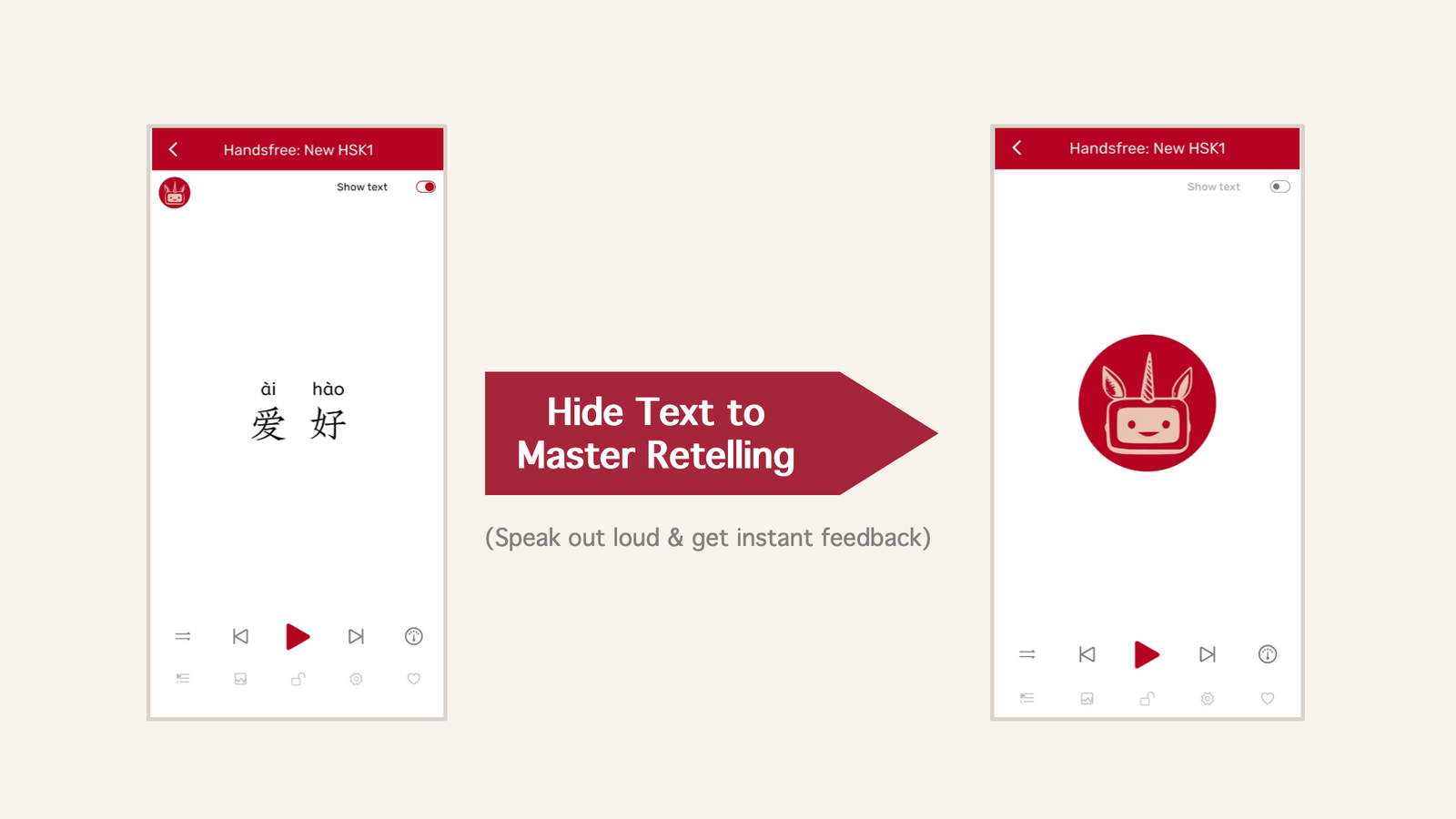
As shown above, when you first start, you can turn on the “Show text” toggle. The app displays the Pinyin and characters (e.g., ài hào / 爱好), helping you build the initial connection between the sound, the shape, and the meaning.
Once you are ready, simply toggle the text off. With the screen blank (or showing just a visual placeholder), you force your brain to rely purely on auditory input, breaking the visual dependency.
After each audio clip plays, the app prompts you to retell the content out loud. Once you finish, CPAIT provides instant, specific feedback on your pronunciation (initials, finals, and tones). Whether you are shadowing essential vocabulary or practicing the rhythmic flow of classical poetry, you are building the exact audio-to-speech loop required for the HSKK.
Combined with adjustable speeds from 0.5x to 1.5x, you can progress from “hearing it clearly” to “reacting quickly.” (Note: A dedicated sentence/paragraph retelling module for HSKK is currently in development—stay tuned!)
Instant, Specific Feedback
CPAIT analyzes your initials, finals, and tones individually. Instead of a vague “good job,” it pinpoints exactly where your tone contour goes wrong, allowing you to correct it immediately before it enters the “fossilization zone.”
HSK 3.0 has doubled the vocabulary requirement, and HSKK demands real-time spoken output. All these changes point in the same direction: Sound is the foundation of Chinese proficiency, not just a decoration.
Build the sounds first, then stack the words. Get the feedback first, then increase the practice volume.
Sounds before words. Feedback from day one.
Ready to build a rock-solid foundation? How to Start Learning Chinese from Zero: The Complete Beginner’s Roadmap
Frequently Asked Questions
When will HSK 3.0 and HSKK officially launch?
The global first exam for both the new HSK 3.0 (written) and the revamped HSKK (speaking) is scheduled for December 13, 2026.
What is the difference between HSK and HSKK?
HSK tests your overall proficiency (listening, reading, writing, and translation), while HSKK is a dedicated Speaking Test. Under the new HSK 3.0 system, the HSKK places heavy emphasis on real-time output, including tasks like “Listen and Retell” and “Describe a Picture”.
How many words and characters do I need for HSK 3.0?
You need to master 11,092 words and 3,000 characters (with 1,200 required for handwriting), along with 572 grammar points.
Why is pronunciation (Pinyin) so critical for the new HSKK?
The HSKK requires immediate spoken output. If your tones are wrong or you rely purely on visual memorization, you will freeze or be misunderstood. Knowing the precise sound of a character anchors it in your memory and ensures your speech is comprehensible to examiners.
Is CPAIT's vocabulary list updated for HSK 3.0?
Yes. While the exam launches in late 2026, the official HSK 3.0 graded vocabulary list was published in the 2021 “Standard for Chinese Proficiency.” CPAIT built its core database strictly on this 2021 standard. Currently, HSK Levels 1–6 are fully updated, with Levels 7–9 in development.
How does CPAIT help me practice for the HSKK "Listen and Retell" task?
CPAIT features a Handsfree Mode with a “Hide Characters” function, forcing you to rely purely on auditory input. Currently, it covers HSK 1-6 vocabulary, Pinyin, and classical poetry to build your foundational listening and shadowing skills. You can adjust the playback speed from 0.5x to 1.5x to improve your reaction time. We are also actively developing a dedicated sentence/paragraph module specifically for the HSKK exam format.