How to Start Learning Chinese from Zero: The Complete Beginner's Roadmap
If you’re starting Chinese from zero, the first decision you make — what to learn first — shapes everything that follows. Get it right, and the rest of the language opens up faster. Get it wrong, and you can spend months practicing in a way that’s hard to undo.
TL;DR: If you’re starting Chinese from zero, learn Pinyin and tones before you memorize hundreds of words. Pronunciation is the foundation of listening, speaking, and vocabulary retention. Errors that aren’t corrected early become harder to fix later. Practice with immediate, specific feedback — ideally a few minutes every day — and you’ll progress faster than learners who spend months drilling vocabulary they can’t pronounce correctly.
What should I learn first in Chinese?
Answer: Pinyin and tones. Not characters, not vocabulary lists, not grammar rules.
Chinese is a tonal language. The same syllable can carry completely different meanings depending on its tone — so learning a word without its tone is not really learning the word. For the full breakdown, see What Are Chinese Tones and Why Do They Matter?.
Most beginners do the opposite. They download a flashcard app, memorize “hello,” “thank you,” “I want coffee,” and skip pronunciation work because it feels slow. Six months later, they have a thousand cards and still can’t be understood.
Pronunciation isn’t a separate skill sitting next to vocabulary and grammar. It’s the medium through which both are expressed. Imperfect grammar can still communicate. Limited vocabulary can still get by. But inaccurate pronunciation can make the words you’ve memorized unrecognizable.
Step 1: Learn Pinyin — the phonetic key to Chinese
Pinyin is the phonetic key to Chinese. It uses Latin letters and tone marks to show how every character is pronounced. For the full breakdown of how many initials, finals, and tones it contains — and why it’s so much faster to learn than characters — read Why Learn Pinyin First? A Smarter Way to Start Mandarin.
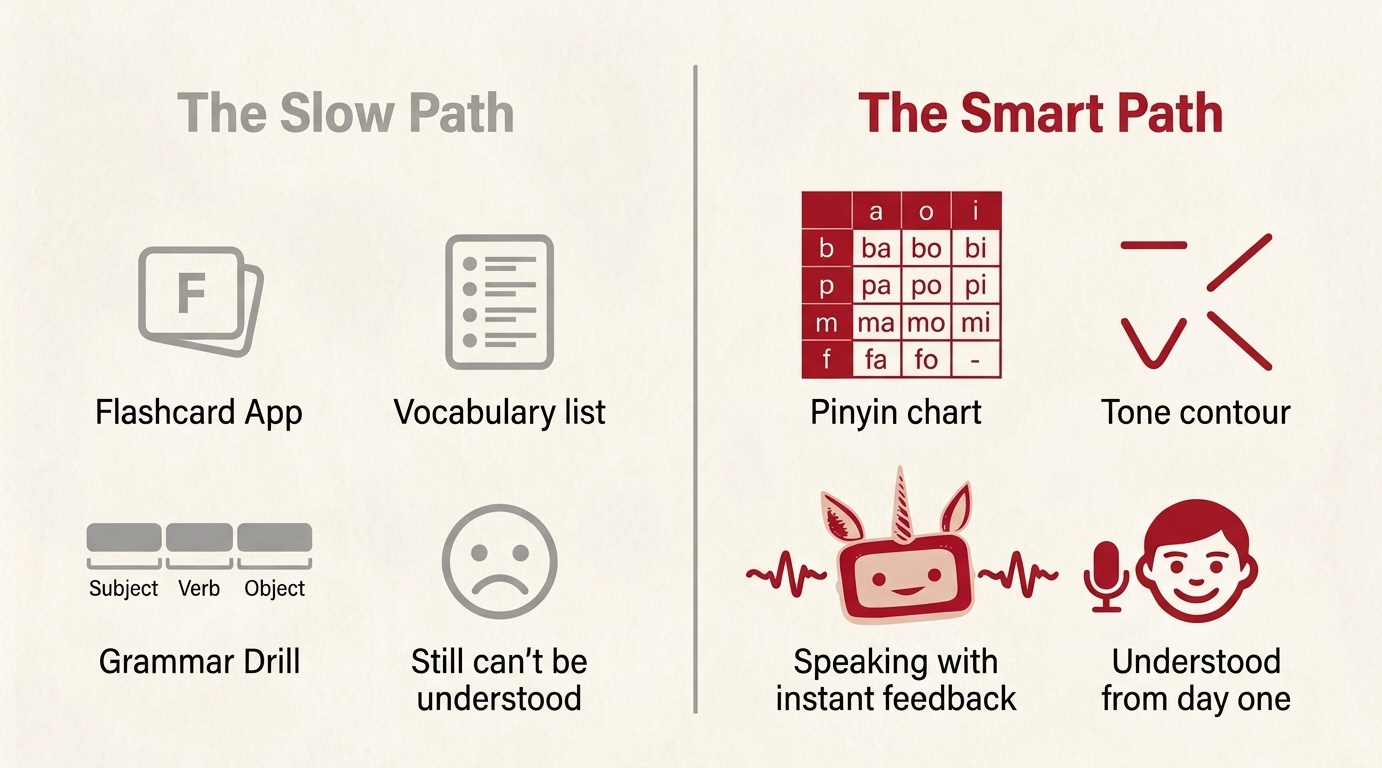
Pinyin is also a long-term tool, not just a beginner crutch. Countless Chinese books and articles include Pinyin alongside characters, so mastering it lets you self-study with confidence later on.
For the complete guide, read Why Learn Pinyin First? A Smarter Way to Start Mandarin.
Step 2: Master the tones — they are the word
Many beginners treat tones as a decorative accent they can pick up later. In Mandarin, that assumption is dangerous. Tone is not an accent on top of the word — it is part of the word. The same syllable can mean completely different things depending on its tone, and native speakers hear those differences as different words, not as accent variations.
Research consistently shows that tone acquisition is the hardest part of Chinese pronunciation for learners from non-tonal languages. Neal’s (2020) study at the University of Cambridge found that tone errors actively impede comprehension — and that learners often can’t hear their own tone errors without feedback. That’s why tones belong at the start, not at the end.
For the four tones, the ma example, tone sandhi, and neutral tones, see What Are Chinese Tones and Why Do They Matter?.
Step 3: Start correcting pronunciation from day one
The best time to start correcting pronunciation is the moment you start learning. Waiting until you’ve built a large vocabulary is one of the most common — and most costly — mistakes learners make. Pronunciation errors don’t wait to be corrected. They become habits.
This is called fossilization — a term first described by Selinker in 1972. Pronunciation is especially prone to it because pronunciation is a motor skill, not just knowledge: once a wrong pattern is practiced long enough, it becomes automatic. A recent longitudinal study of adult Chinese learners confirmed that pronunciation is the most severely fossilized dimension — even as grammar and vocabulary continue to improve (马帅航, 2024).
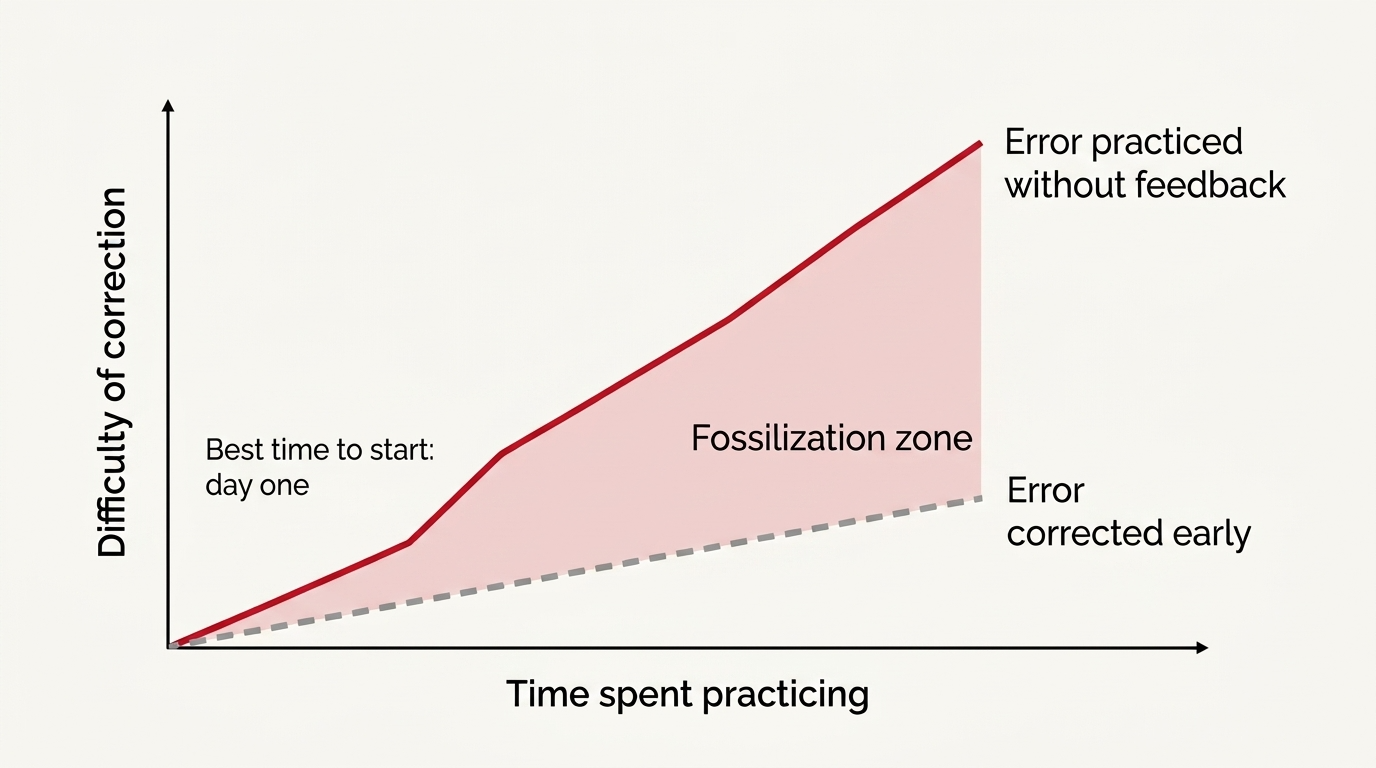
The cost of correcting a fossilized error is far higher than the cost of learning it correctly from the start.
For the full explanation of why waiting makes correction harder, see Why Can’t I Understand Chinese After Years of Studying?. For the deeper science of why waiting makes it harder, read How Can I Fix My Chinese Pronunciation?.
Step 4: Practice with immediate, specific feedback
Motor skill research shows that immediate feedback is far more effective than delayed feedback. A tennis player who only finds out whether their serve went in after a two-minute delay cannot adjust their motion in real time. Pronunciation works the same way. Saito and Lyster (2012) demonstrated that learners who received targeted corrective feedback improved significantly, while control groups did not.
What learners need is:
Immediate, specific feedback — not just a score like “80% accurate”,but whether the error is in the initial, the final, or the tone.
Contextualized practice — real speech involves tone sandhi, stress patterns, and intonation.
Consistency and volume — a few minutes every day beats a once-a-week cram session.
This is the design philosophy behind CPAIT, an AI-powered Chinese pronunciation trainer. For beginners, three modules matter most — and they work together:
A systematic Pinyin course — 28 mini-lessons, 2–15 minutes each, taking you from “a o e” to confident production. You learn and practice at the same time, with instant feedback as you go.
HSK 1–6 vocabulary expansion — at the bottom of each Pinyin unit practice page, you’ll see vocabulary that matches that sound. Click to jump straight into practicing those words.
Handfree mode — screen-free listening and shadowing, matched to the content you’ve already learned. Speed is adjustable from 0.5x to 1.5x, and playlists are fully customizable.
These three modules share the same content: you learn a sound in the Pinyin course, practice it with HSK vocabulary, and reinforce it in Handfree mode. Nothing gets lost between tools.
For dimension-level diagnostics — telling you whether the error is in the initial, the final, or the tone — see How Can I Fix My Chinese Pronunciation?. For the full learning–practice–Handfree loop, see How to Improve Chinese Listening and Speaking.
Because Handfree is screen-free, you can practice during your commute, on a walk, or while doing dishes — turning pronunciation practice into a daily habit.
For the full practice guide, read How to Improve Chinese Listening and Speaking.
The Bottom Line
Pronunciation isn’t a “nice to have” you can bolt on at the end. It’s the foundation everything else is built on. Vocabulary without pronunciation is inert. Grammar without pronunciation is theoretical. Fluency without pronunciation is an illusion.
If you’re serious about Chinese, start with your pronunciation. Not because it’s easy, but because everything else depends on it.
CPAIT was built around this path: a 28-lesson Pinyin course, HSK 1–6 vocabulary, and Handfree mode that share the same content. Learning, practice, and Handfree reinforce each other, so nothing gets lost between tools. For dimension-level diagnostics, see How Can I Fix My Chinese Pronunciation?. For the full loop, see How to Improve Chinese Listening and Speaking.
If you’d like to try it, you can download CPAIT on the App Store or Google Play.
References
马帅航. (2024). 南非祖鲁语背景下成人中高级汉语学习者语音石化现象及对策研究 [硕士论文]. 郑州大学.
Neal, R. (2020). Knocking tones off their perch: Investigating the intelligibility of Anglophone beginner learners of Mandarin Chinese at two secondary schools in the North of England [PhD thesis]. University of Cambridge.
Saito, K., & Lyster, R. (2012). Effects of form-focused instruction and corrective feedback on L2 pronunciation development of /ɹ/ by Japanese learners of English. Language Learning, 62(2), 595–633.
Selinker, L. (1972). Interlanguage. IRAL — International Review of Applied Linguistics in Language Teaching, 10(1–4), 209–232.
Further Reading
- Why Learn Pinyin First? A Smarter Way to Start Mandarin
- What Are Chinese Tones and Why Do They Matter?
- Why Can’t I Understand Chinese After Years of Studying?
- How Can I Fix My Chinese Pronunciation?
- How to Improve Chinese Listening and Speaking: The 3 Foundations Most Learners Miss
Frequently Asked Questions
How long does it take to learn Chinese pronunciation?
You can learn the basics of Pinyin and the four tones in a few weeks of focused practice. But mastering them — especially in connected speech — takes months of consistent, feedback-driven practice. Start early and practice daily, even if only for 10 minutes.
Do I need to learn Pinyin before characters?
Yes. Pinyin gives you a precise map of the sound system. Without it, you’re guessing at pronunciation. Learning characters without Pinyin is like learning to read music without knowing what the notes sound like.
Can I learn Chinese without learning tones?
No. Tones are not optional. They’re part of the word. If you ignore them, you’ll be misunderstood, and you’ll have to relearn everything later.
Is it too late to fix my pronunciation if I've been learning for years?
It’s harder, but not impossible. For the full explanation, see How Can I Fix My Chinese Pronunciation?.
What's the best way to practice Chinese tones?
Listen and repeat with immediate feedback. For the full method, see What Are Chinese Tones and Why Do They Matter?.