How to Improve Chinese Listening and Speaking: The 3 Foundations Most Learners Miss
If you’ve been trying to improve your Chinese listening and speaking by “listening more” and “speaking more,” you may have noticed that effort alone doesn’t seem to move the needle. Direction isn’t method. Without the right foundations, more effort just reinforces the wrong patterns.
TL;DR: Improving Chinese listening and speaking comes down to three foundations: accurate pronunciation, massive Chinese listening input (磨耳朵), and shadowing. Most learners do one or two — rarely all three, and rarely in a way that connects them. This article breaks down what makes each one hard, and how CPAIT’s learning–practice–Handfree loop keeps them working together.
Why “listen more, speak more” doesn’t improve Chinese listening and speaking
Answer: Because it’s a direction, not a method. Progress depends on whether your Chinese listening input is standard, appropriately difficult, and speed-controllable — and whether your spoken output gets immediate, specific feedback.
Most learners assume that enough Chinese listening and speaking will eventually produce improvement. It sounds reasonable. But many learners spend years doing exactly that and still can’t fully understand native speakers, or be understood by them.
The problem is that “more” doesn’t specify the conditions:
Is the audio standard and accurate?
Is the difficulty appropriate — not too hard, not too easy?
Can you control the speed?
Are you re-listening to content you’ve already learned?
When you speak, do you know specifically what went wrong?
Are you correcting errors before they become habits?
Get these conditions right, and improvement follows. Get them wrong, and practice just cements the wrong patterns.
The 3 foundations — and why they’re a sequence, not a list
Answer: Accurate pronunciation, massive Chinese listening input (磨耳朵), and shadowing.
These aren’t parallel skills. They’re a progression:
Accurate pronunciation is the foundation. If your pronunciation is off, both listening and speaking suffer. (We’ve written separately about how to fix Chinese pronunciation and how tones work — here we focus on how pronunciation feeds Chinese listening.)
Massive Chinese listening input is the fuel. Your ear needs a correct model of the sound system before your mouth can produce it.
Shadowing is the bridge. It trains listening, pronunciation, and speech flow at the same time — turning input into output.
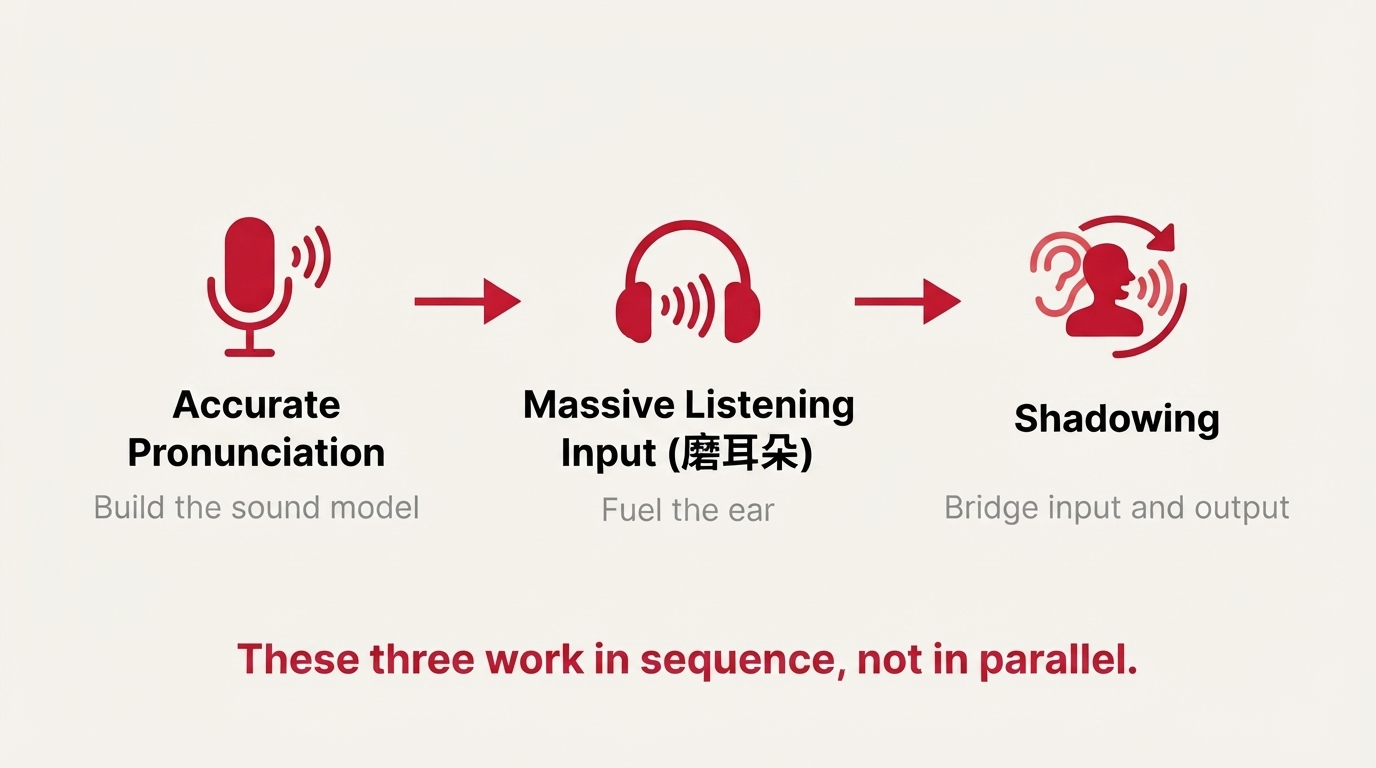
Most learners do one or two. The ones who plateau usually skip the third, or do all three with separate tools that don’t talk to each other.
Let’s look at what makes each one hard — and what “doing it right” actually requires.
Foundation 1: Accurate Chinese pronunciation
Why it’s the foundation of Chinese listening, not just speaking
Pronunciation isn’t only about being understood. It’s also about understanding. If your brain has no reliable production model for a sound, it has no reliable reference for recognizing that sound when a native speaker says it. This perception–production link is why pronunciation work pays off twice — once in your mouth, once in your ear.
This bidirectional relationship has been documented in second language speech research. Kissling (2018) found that pronunciation instruction improved learners’ bottom-up processing for listening: learners who received instruction on suprasegmental features followed by perception-focused practice found target-language speech more intelligible than controls. This suggests that pronunciation training directly benefits perception, not just production.
The practical consequence: if your tones are off, fast native speech won’t sound fast. It will sound blurry — because your brain lacks the model to match it against.
For the deeper link between perception and production, see Why Can’t I Understand Chinese After Years of Studying?.
What makes Chinese pronunciation hard
Four difficulties, in rough order of persistence:
Tones. Chinese is tonal. The same syllable ma can mean “mother” (mā), “hemp” (má), “horse” (mǎ), or “scold” (mà) — different words, not accent variants. For learners from non-tonal backgrounds, tone is a new perceptual category. (For a full treatment, see What Are Chinese Tones and Why Do They Matter?.)
Tone sandhi. Tones shift with position. 你好 (nǐ hǎo) is written with two third tones but pronounced ní hǎo. These rules cause persistent errors even at advanced levels.
Sound contrasts your native language lacks. Aspirated vs. unaspirated (b/p, d/t, g/k), retroflex vs. alveolar (zh/z, ch/c, sh/s), and vowel contrasts like ü vs. u. What you can’t hear, you can’t produce — and what you can’t produce, you can’t hear.
No feedback. This is the biggest one. Neal’s (2020) study found that learners have low awareness of their own pronunciation errors. Without external feedback, most learners rehearse the wrong pattern hundreds of times without knowing it. For the full study, see What Are Chinese Tones and Why Do They Matter?.
Foundation 2: Massive Chinese listening input (磨耳朵)
Why Chinese listening input matters
Chinese listening input is the foundation of speaking. Before you can produce natural-sounding Chinese, your ear needs a large volume of correct input — what learners call 磨耳朵, “grinding the ear.” Without it, you may know a word intellectually but fail to recognize it at natural speed.
Start with content you’ve already learned and practiced. The most effective early Chinese listening input isn’t random native content — it’s material your brain already has a reference for. When you listen to something you’ve studied, your brain can match what it hears to what it knows. When you listen to unfamiliar content too early, listening becomes guessing.
Once the content is familiar, more is better. Get as much Chinese listening input as you can, start slow and work up to natural speed, and don’t treat it as serious study. Treat it like music — anytime, anywhere, relaxed.
What makes Chinese listening input hard
Four difficulties:
Finding standard pronunciation. Not all audio is accurate. Some is recorded by non-native speakers, some has regional accents, some has background noise. Wrong input teaches the ear the wrong thing.
Finding the right difficulty. Too hard becomes noise; too easy doesn’t stretch you. The target is “i+1” — just above your current level. That sweet spot is hard to find manually.
Speed isn’t controllable. Real native speech is fast, reduced, and full of connected speech. Learners who only hear natural speed often can’t catch individual words, let alone tones.
Listening to unfamiliar content too early. A common mistake is “immersing” in native content never studied before. Without prior familiarity, listening becomes guessing — and guessing doesn’t build the ear.
Foundation 3: Shadowing Chinese audio
Why shadowing works
Shadowing means speaking along with native audio in real time, matching rhythm, tone, and intonation as closely as possible. It’s one of the most efficient ways to build Chinese listening and speaking fluency simultaneously, because it forces you to:
Listen actively, not passively — you can’t shadow without parsing.
Produce sounds in real time, not at your own pace.
Match prosody, not just individual sounds — rhythm, stress, intonation.
Build muscle memory for natural speech patterns.
Shadowing’s effectiveness has a cognitive basis. Kadota (2019) explains that shadowing activates the phonological loop in working memory, the system responsible for temporarily holding and rehearsing speech sounds. By repeating incoming speech aloud, learners strengthen the rehearsal mechanism that links perception and production — which is why shadowing trains listening and speaking at the same time.
It’s the bridge between input and output.
What makes shadowing hard
Four difficulties:
Finding suitable content. You need the right speed, difficulty, and length. Too fast and you can’t keep up; too slow and it doesn’t train real speech; too long and you lose focus.
No immediate feedback. When you shadow, you don’t know if you’re matching accurately. Your voice sounds different to you than to others. Without feedback, you can shadow incorrectly for months.
No correction mechanism. Even if you sense something is off, you don’t know what to fix — tone, initial, rhythm? Without specific feedback, correction is guesswork.
No systematic accumulation. Most learners shadow random content — a podcast here, a video there — with no record of what was practiced, no tracking, no way to revisit problem areas.
How CPAIT helps you improve Chinese listening and speaking
Answer: CPAIT is a complete Chinese learning solution designed around pronunciation. Its in-house speech assessment engine is built to judge whether you pronounced something correctly, not just to recognize what you said. Most Chinese learning apps rely on speech recognition — they identify the word you were aiming for and move on. CPAIT breaks every attempt down by initial, final, and tone, so a single wrong tone or final still counts as an error.
It can feel stricter than other apps. Maybe you feel it’s too strict. Guilty as charged — we’re pronunciation-obsessed on purpose. That’s how pronunciation problems get caught early, instead of quietly turning into habits.
CPAIT is built around three foundations: accurate pronunciation, massive Chinese listening input (磨耳朵), and shadowing. What makes it different isn’t any single feature — it’s that learning, practice, and Handfree mode share the same content, so all three reinforce each other.
Most tools handle one piece. A pronunciation app gives feedback but no Chinese listening input. A podcast app gives audio but no correction. A flashcard app builds vocabulary but ignores pronunciation. You end up juggling apps, and nothing carries over.
How CPAIT’s learning–practice–Handfree loop works
Pronunciation. A 28-lesson Pinyin Bootcamp (2–15 minutes each) takes you from “a o e” to confident production. At the end, an assessment identifies your specific problems — even ones you didn’t know you had — with accuracy above 95%. Dedicated mini-lessons cover tone sandhi (8) and neutral tones (8), the two areas that cause the most persistent errors. For the full method, see How Can I Fix My Chinese Pronunciation?.
Chinese listening input. Handfree mode is screen-free listening and practice for commutes, the gym, or chores. Speed is adjustable from 0.5x to 1.5x. Playlists are fully customizable — content, order, format, repetitions. Crucially, the content is what you’ve already learned in the app, which is exactly the “familiar content, slow to fast” approach that makes 磨耳朵 effective. HSK 1–6 vocabulary, classic poems, and crafted sentences give you progressively richer material.
Shadowing. Handfree mode doubles as a shadowing environment: real-time audio cues tell you whether your rhythm and tone match, and a post-session report breaks down accuracy, fluency, and tone stability. When you hit a difficult unit, one click saves it to your Study Set — a personal folder of problem areas for repeated practice.
The loop is the point. Learn a unit → practice it → take it into Handfree for Chinese listening input and shadowing → review the report → jump back into targeted correction. Nothing gets lost between tools. Every minute of learning feeds practice, and every minute of practice feeds Handfree.
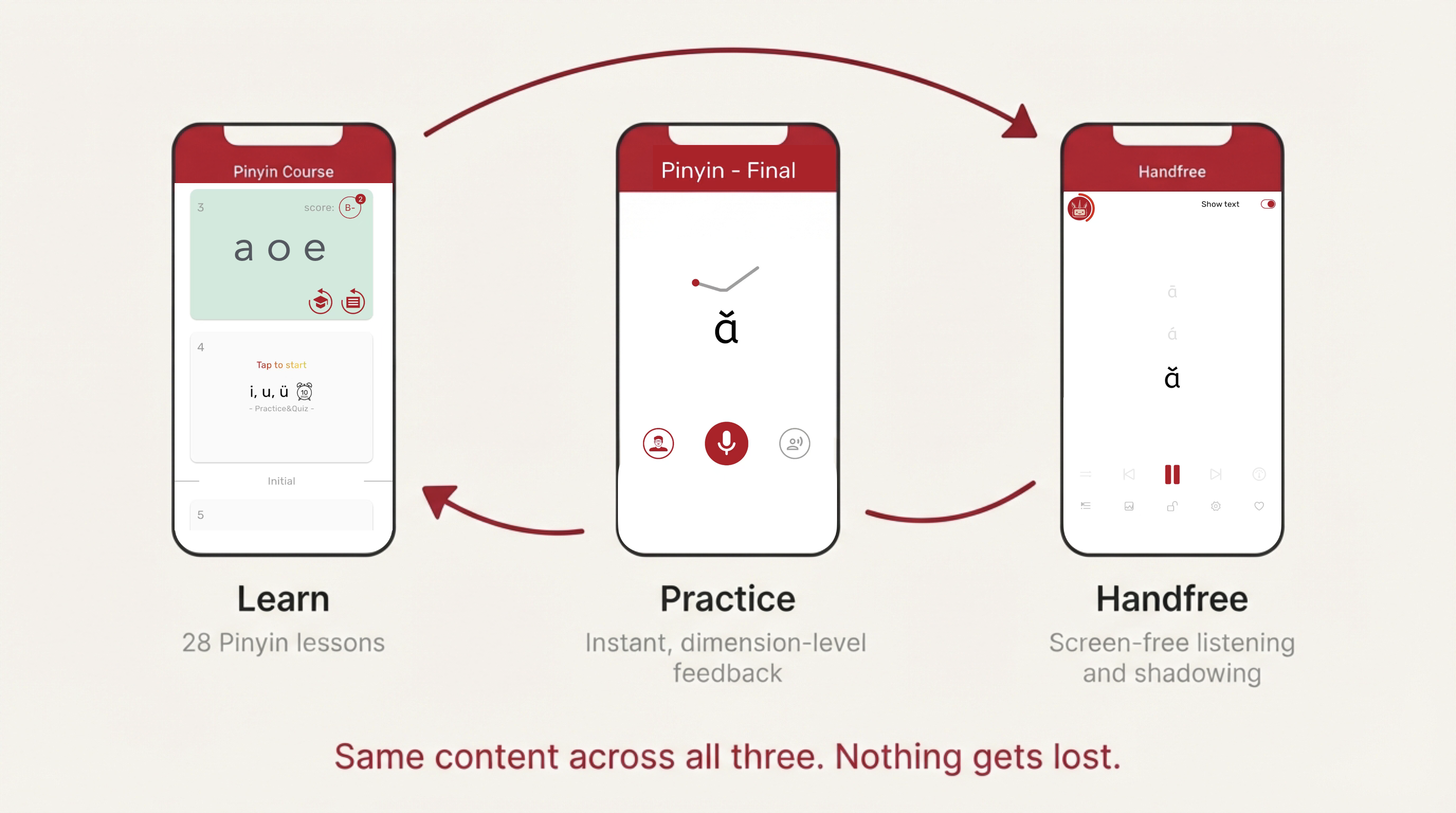
For dimension-level diagnostics — telling you whether the error is in the initial, the final, or the tone — see How Can I Fix My Chinese Pronunciation?.
The Bottom Line
Improving Chinese listening and speaking isn’t about “listening more” or “speaking more.” It’s about getting three foundations right — and connecting them.
Pronunciation suffers from tones, tone sandhi, unfamiliar contrasts, and no feedback. Chinese listening input suffers from non-standard audio, wrong difficulty, uncontrollable speed, and unfamiliar content. Shadowing suffers from unsuitable material, no immediate feedback, no correction, and no accumulation.
CPAIT was built so that learning, practice, and Handfree mode share the same content. What you learn is what you practice; what you practice is what you shadow. Nothing is wasted, and everything builds.
Ready to try it? Download CPAIT for iOS or Android — Handfree mode combines pronunciation diagnostics, controllable Chinese listening input, and shadowing with real-time feedback in one system.
References
Kadota, S. (2019). Shadowing as a practice in second language acquisition: Connecting inputs and outputs. Routledge.
Kissling, E. M. (2018). Pronunciation instruction can improve L2 learners’ bottom-up processing for listening. The Modern Language Journal, 102(4), 653–675.
Neal, R. (2020). Knocking tones off their perch: Investigating the intelligibility of Anglophone beginner learners of Mandarin Chinese at two secondary schools in the North of England [PhD thesis]. University of Cambridge.
Saito, K., & Lyster, R. (2012). Effects of form-focused instruction and corrective feedback on L2 pronunciation development of /ɹ/ by Japanese learners of English. Language Learning, 62(2), 595–633.
Yenkimaleki, M., van Heuven, V. J., & Afshar, H. S. (2023). The efficacy of segmental/suprasegmental vs. holistic pronunciation instruction on the development of listening comprehension skills by EFL learners. Language Learning Journal, 51(6), 734–748.
Further Reading
- How to Start Learning Chinese from Zero: The Complete Beginner’s Roadmap
- Why Learn Pinyin First? A Smarter Way to Start Mandarin
- What Are Chinese Tones and Why Do They Matter?
- Why Can’t I Understand Chinese After Years of Studying?
- How Can I Fix My Chinese Pronunciation?
Frequently Asked Questions
How do I improve Chinese listening and speaking at the same time?
Work the three foundations in sequence: pronunciation first (it’s the base for both), then Chinese listening input, then shadowing to connect them. CPAIT integrates all three in one system so you’re not switching tools.
Is shadowing Chinese audio better than just listening?
They do different jobs. Chinese listening input builds your ear’s model; shadowing trains you to produce that model in real time. Both are necessary — but shadowing without feedback can reinforce errors, so immediate correction matters.
How much Chinese listening input (磨耳朵) should I get every day?
As much as you can — as long as the content is effective. With the right material, more Chinese listening input is better: massive, repeated listening is what builds your ear’s model. Start slow and work up to natural speed. And it doesn’t have to feel like serious study. You can treat it like listening to music — anytime, anywhere, relaxed. The key is that the content is standard, appropriately difficult, speed-controllable, and familiar. Given those conditions, frequency and volume matter more than session length.
What Chinese audio should I use for shadowing?
Standard pronunciation, appropriate difficulty, controllable speed — ideally content you’ve already studied. CPAIT’s Handfree mode uses the same content you’ve learned in the app, so nothing is unfamiliar.
Can I improve Chinese listening and speaking without a teacher?
Yes — if you have feedback. Without it, you can’t hear your own errors and may practice incorrectly for months. An AI tool like CPAIT provides immediate, dimension-level feedback without a human teacher. For the full method, see How Can I Fix My Chinese Pronunciation?