How Can I Fix My Chinese Pronunciation? (And Why It Gets Harder Over Time)
If you’ve been learning Chinese for years and still struggle with pronunciation, you might wonder: is it too late to fix? The short answer is no. But the longer you wait, the harder it gets — and here’s why.
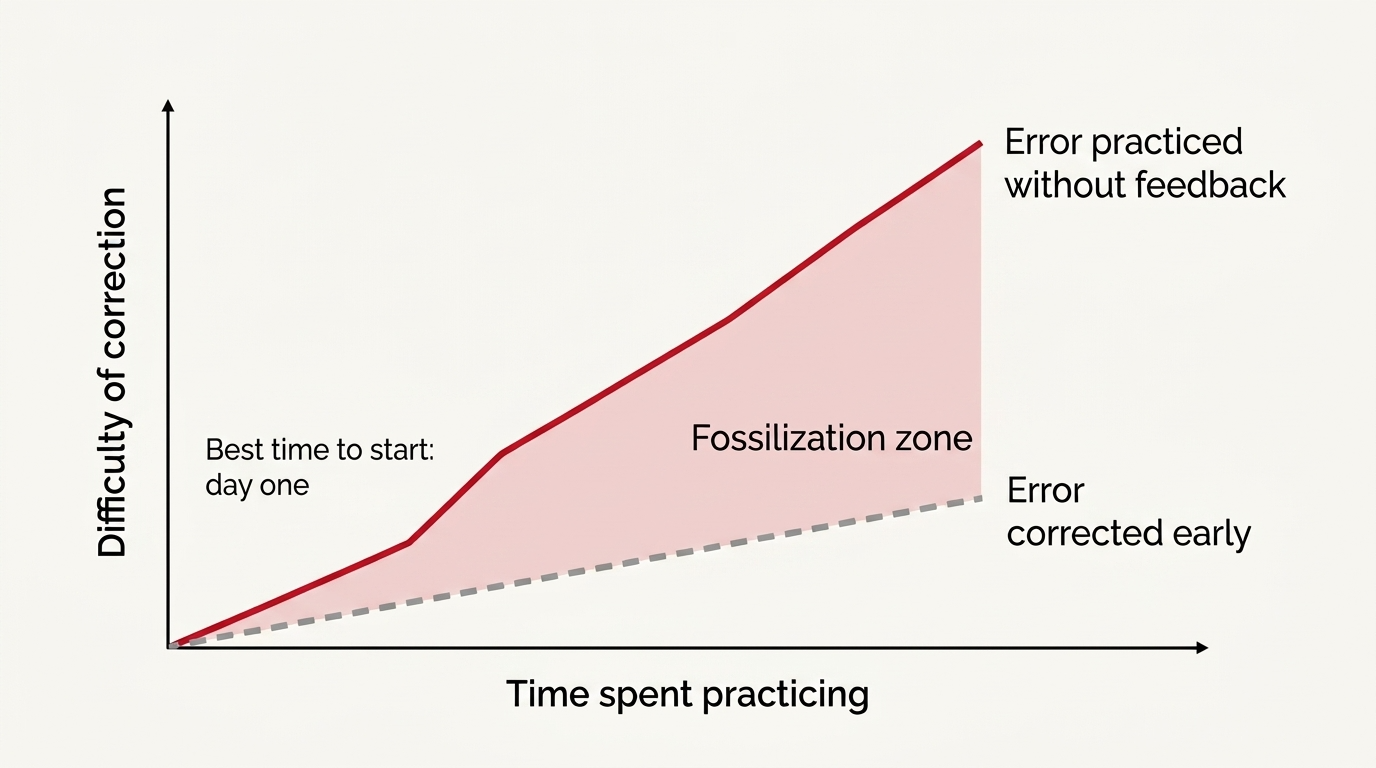
TL;DR: Yes, you can fix your Chinese pronunciation at any stage. But pronunciation errors don’t stay neutral — they fossilize. The longer an incorrect pattern is practiced, the more automatic it becomes, and the harder it is to undo. The good news: with immediate, dimension-level feedback and consistent practice, even long-standing errors can be corrected. The sooner you start, the easier it is.
Is it too late to fix my Chinese pronunciation?
Answer: No — it’s never too late. But the difficulty increases with time.
If you’ve been learning Chinese for years and still struggle with tones, initials, or finals, you’re not alone. Many intermediate and advanced learners reach a point where they feel stuck: they can read and write well, but speaking still feels unreliable, and native speakers still sometimes struggle to understand them.
It’s natural to wonder whether the window has closed — whether pronunciation is something you either “get right early” or never fix. That’s not how it works. Pronunciation can be improved at any stage. The question isn’t whether you can fix it, but how much effort it will take.
And that effort depends largely on one thing: how long the error has been practiced.
Why is it harder to fix pronunciation the longer I wait?
Answer: Because pronunciation is a motor skill. Every time you repeat a sound, you’re training your muscles. If you train them incorrectly, the wrong pattern becomes automatic — and automatic patterns are hard to override.
Learning a grammar rule is like learning a fact: you can read it, understand it, and apply it. Learning a pronunciation pattern is like learning to play a musical instrument: it requires repeated physical practice. Once you’ve practiced incorrectly for long enough, the incorrect pattern becomes automatic.
This is the phenomenon of fossilization — first described by Selinker in 1972. It refers to non-target language patterns that become permanently stabilized in a learner’s interlanguage, “no matter what the age of the learner or the amount of explanation and instruction he receives in the target language” (Selinker, 1972: 205).
Fossilization doesn’t mean errors can never be fixed. It means they become resistant to change — especially through passive exposure alone. Fixing a fossilized error requires not just knowing the correct form, but actively retraining the motor pattern that produces it.
What does research say about pronunciation fossilization?
Answer: Longitudinal studies of Chinese learners confirm that pronunciation errors tend to stabilize over time — even as other aspects of language improve.
A recent study of adult intermediate and advanced Chinese learners at the Confucius Institute at Durban University of Technology followed learners over a three-month period. Researchers found that learners’ target language pronunciation showed clear signs of fossilization — a “pronunciation plateau” in which “regardless of how much or how long the learner exerts effort, the relevant pronunciation items cease to develop further and remain in a stable or even regressive state” (马帅航, 2024).
Crucially, the study noted that among the three dimensions of language — pronunciation, grammar, and vocabulary — pronunciation was the most severely affected by fossilization. In other words, even as learners continued to acquire new vocabulary and refine their grammar, their pronunciation stopped improving.
This is why “just keep practicing” isn’t enough. Without targeted feedback, practice reinforces whatever pattern you’re already using — right or wrong.
Can fossilized pronunciation errors actually be corrected?
Answer: Yes — but it takes focused, high-volume practice with immediate feedback.
The key word is feedback. Neal’s (2020) study at the University of Cambridge found that learners demonstrate low awareness of their own pronunciation errors, and that more intelligible learners are generally more aware of their errors. In other words, the learners who most need correction are often the least equipped to hear their own mistakes.
You cannot fix what you cannot hear. That’s why feedback is essential — and why it needs to be:
Immediate. Delayed feedback (like waiting for a teacher’s comments a day later) allows the error to be repeated dozens of times in between.
Specific. Knowing “something is wrong” isn’t enough. You need to know whether the error is in the initial, the final, or the tone.
Actionable. Feedback should lead directly to targeted practice on the specific error — not just a score.
Research on corrective feedback supports this. Saito and Lyster (2012) demonstrated that learners who received targeted corrective feedback showed significant improvement in producing difficult phonemes, while control groups did not. Their findings established corrective feedback as a critical variable in pronunciation acquisition.
How long does it take to fix pronunciation errors?
Answer: It depends on how deeply the error has fossilized. A recently formed error can be corrected in days or weeks. An error practiced for years may take months of focused work.
Think of it this way:
If you’ve been practicing the error for a few weeks: correction is relatively quick. A few sessions of focused feedback can reset the pattern.
If you’ve been practicing the error for a few months: correction takes longer. You need to both unlearn the old pattern and build the new one.
If you’ve been practicing the error for years: correction is possible, but it requires sustained, high-volume practice with immediate feedback. The old pattern is deeply automatic, and you’re essentially retraining a motor habit.
This is why starting early matters. Every day you practice without correction is another day the error gets stronger.
How can I fix my pronunciation if I’ve been learning for years?
Answer: Go back to the foundation, practice with immediate feedback, and be consistent.
Here’s what CPAIT offers for pronunciation correction:
Instant pronunciation feedback — not just speech recognition. Most Chinese learning apps rely on speech recognition. They identify the word you were aiming for, give you a holistic score, and move on. CPAIT takes a different approach. Its speech assessment engine is built to judge whether you actually pronounced the sound correctly, and it holds a stricter standard. Every smallest practice unit you submit gets immediate feedback across three dimensions — initial, final, and tone. A single wrong tone or final still counts as an error, even if the word is recognizable. That immediate, dimension-level loop ensures pronunciation problems get corrected right away, instead of being repeated dozens of times unnoticed.
A systematic pronunciation curriculum and self-directed practice content. CPAIT covers Pinyin, tone sandhi, and neutral tones as structured courses. Beyond the lessons, you get self-directed practice you can navigate freely — Pinyin syllables, words, and short passages. Move between them at will to break down a pronunciation problem or extend your learning beyond the course.
Pronunciation analysis in My CPAIT. Your instant feedback is per attempt. My CPAIT has a dedicated pronunciation analysis module that aggregates your practice data over time. It shows your overall accuracy across initials, finals, and tones, and highlights your most error-prone sounds in each dimension. That makes it easy to see your weak spots and build targeted practice around them, instead of reviewing what you already know.
Handfree mode. It turns fragmented time — commuting, chores, walking — into screen-free listening and shadowing practice. You can repeat the same sound hundreds of times, no screen required, no pressure.
If you’re an advanced learner who still struggles with speaking and listening in real conversations, it’s worth trying CPAIT and looking at pronunciation as a possible root cause. If you’ve already learned Pinyin, you can start directly with the final assessment at the end of CPAIT’s Pinyin course. That assessment is a basic ability test covering all the pronunciation elements Chinese requires. It helps you see where your pronunciation stands right away, and locks in the direction you need to practice and improve.
The loop is simple: find it, fix it, keep it fixed. Not one giant overhaul — just a focused, ongoing process that fits into daily life.
There’s one more advantage worth mentioning: because CPAIT is AI, it’s available 24/7. You can practice whenever you want, for as long as you want. It will repeat the same syllable with you a hundred times without losing patience — and without making you feel judged. For learners with fossilized errors, that matters more than it might seem. Practicing with a real person can feel embarrassing or frustrating — especially when you’re repeating the same sound over and over. With an AI tutor, there’s no pressure, no embarrassment, and no limit on repetition.
The Bottom Line
Can you fix your Chinese pronunciation? Yes. At any stage, at any level. But the longer you wait, the harder it gets — because pronunciation errors fossilize, and fossilized errors are resistant to change.
The good news is that the fix isn’t mysterious. It’s focused, high-volume practice with immediate, dimension-level feedback. The sooner you start, the easier it is. And if you’ve already been learning for years, don’t assume it’s too late — it’s just harder, and the sooner you start, the easier it gets.
Ready to fix your pronunciation? Download CPAIT on the App Store or Google Play — pronunciation diagnostics give dimension-level feedback on every attempt, so you always know exactly what to fix.
References
Neal, R. (2020). Knocking tones off their perch: Investigating the intelligibility of Anglophone beginner learners of Mandarin Chinese at two secondary schools in the North of England [PhD thesis]. University of Cambridge.
Saito, K., & Lyster, R. (2012). Effects of form-focused instruction and corrective feedback on L2 pronunciation development of /ɹ/ by Japanese learners of English. Language Learning, 62(2), 595–633.
Selinker, L. (1972). Interlanguage. IRAL — International Review of Applied Linguistics in Language Teaching, 10(1–4), 209–232.
马帅航. (2024). 南非祖鲁语背景下成人中高级汉语学习者语音石化现象及对策研究 [硕士论文]. 郑州大学.
Further Reading
- How to Start Learning Chinese from Zero: The Complete Beginner’s Roadmap
- Why Learn Pinyin First? A Smarter Way to Start Mandarin
- What Are Chinese Tones and Why Do They Matter?
- Why Can’t I Understand Chinese After Years of Studying?
- How to Practice Chinese Listening and Pronunciation Effectively
Frequently Asked Questions
Is it too late to fix my Chinese pronunciation?
No. Pronunciation can be improved at any stage. But the longer an error has been practiced, the more effort correction takes. The sooner you start, the easier it is.
What is pronunciation fossilization?
Fossilization is the process by which non-target language patterns become permanently stabilized in a learner’s interlanguage. It was first described by Selinker in 1972. Pronunciation is especially prone to fossilization because it’s a motor skill.
Can fossilized pronunciation errors really be fixed?
Yes — with focused, high-volume practice and immediate feedback. It’s harder than learning correctly from the start, but it’s not impossible. The key is targeted practice that addresses the specific error, not just general repetition.
How long does it take to fix pronunciation errors?
It depends on how deeply the error has fossilized. A recently formed error can be corrected in days or weeks. An error practiced for years may take months of focused work.
Do I need a teacher to fix my pronunciation?
Not necessarily. You need feedback — specific, immediate, and dimension-level. An AI-powered tool like CPAIT can provide that feedback without a human teacher, which makes daily practice more accessible and less intimidating.
Why can't I hear my own pronunciation errors?
That’s normal. Neal’s (2020) study found that learners demonstrate low awareness of their own pronunciation errors. More intelligible learners are generally more aware of their errors — but even they benefit from external feedback. You need a reference outside yourself to hear what you can’t hear.
Should I go back to Pinyin if I already know it?
Yes. Many fossilized errors trace back to sounds that were never fully mastered. Going back to Pinyin and tones — with fresh feedback — can reveal problems you didn’t know you had.
How does CPAIT help with fossilized pronunciation errors?
CPAIT provides dimension-level diagnostics on every attempt — telling you whether the error is in the initial, the final, or the tone. Its assessment accuracy is above 95%, so you can trust the feedback. And its Handfree mode lets you practice without looking at a screen, making daily practice easy to sustain — even when you’re correcting long-standing errors.